Mold in the Garage in Las Vegas
If you are seeing mold in the garage, dark speckling on the drywall near the floor, a fuzzy patch behind the water heater, or a musty smell that hits you the moment you open the door from the house, your first instinct is usually right: something in that space is staying wet. Mold does not grow on dry surfaces. In a Las Vegas garage, visible growth is almost always a sign that moisture is getting in or being trapped somewhere you have not looked yet.
The good news is that a garage problem caught early is one of the more manageable ones we see, as long as you treat the cause and not just the stain. Wiping it off with bleach feels like a fix, but if the source is still feeding it, the growth comes back within weeks, usually a little wider than before. The right move is to find out why that wall, that corner, or that ceiling is wet, then dry it, clean it to standard, and verify the result.
 Mold growth along the lower drywall of a Las Vegas residential garage near the water heater
What mold in a Las Vegas garage usually means
Las Vegas is a desert, so a lot of homeowners assume mold is impossible here. It is not. The valley creates its own pockets of moisture, and the attached garage is one of the most common places they collect, because it is poorly ventilated, rarely conditioned, and full of the porous materials mold loves: paper-faced drywall, cardboard boxes, stored fabric, and wood framing. When growth appears, the cause is almost always one of a short list of desert-specific culprits.
The water heater or its drain pan. Many Las Vegas garages house the water heater. A slow tank seep, a sweating cold-water line, or a cracked drain pan can keep the slab and the lower drywall damp for months before you notice the staining above it.
Hidden plumbing or a slab leak. Slab-on-grade construction is the norm here, and a pinhole leak in a line running through or under the slab can wick moisture up into the garage wall. A persistently damp spot on the concrete, or efflorescence, that white chalky crust, often points to water moving through the slab.
AC condensation and the air handler. When the air handler or condensate line lives in the garage, a clogged or disconnected condensate drain can drip onto the floor or into a wall cavity all summer. The garage stays warm and humid right where the cold equipment sweats, which is an ideal recipe for growth.
Monsoon intrusion and the garage door. Our summer monsoon storms arrive fast and hard. Wind-driven rain pushes water under the garage door, through a failed door seal, or through cracks where the slab meets the wall, soaking the bottom plate and the drywall above it. A swamp cooler venting nearby, or a swamp cooler line run through the garage, can add humidity to an already vulnerable space.
Honest diagnosis matters here, because the fix is completely different depending on which of these is happening. That is why we never quote a remediation over the phone. We come out, find the actual source, and tell you what we find, even when the answer is smaller than you feared.
Need help now?
Talk to a Las Vegas expert
In-house certified crews. One-hour emergency response across the valley, 24/7.
Why it matters and how urgent it is
A garage is not sealed off from the house. The door between the garage and the living space, the shared attic, and the HVAC returns all give spores and musty odors a path indoors. So the idea that garage mold can wait because it is out in the garage is one of the more expensive assumptions a homeowner can make. What starts as a patch on the garage drywall can seed problems in the wall it shares with a bedroom or the attic above it.
There is also a clock on the moisture itself. Once building materials are wet, mold can begin colonizing within roughly 24–48 hours, and after about 72 hours the conversation shifts from clean and save to remove and remediate. If the source is an active leak, a dripping condensate line, a seeping water heater, monsoon water still finding its way in, the damage is growing every day it runs. That does not always mean it is an emergency, but it does mean the source needs to be stopped soon, not next season.
Health-wise, we do not trade in fear. Most healthy people tolerate incidental exposure, but a garage that smells musty enough to notice through a closed door is putting spores into air the household breathes, and that matters more for anyone with asthma, allergies, or a compromised immune system. The calm, correct response is to verify what is there and deal with the cause, not to panic and not to ignore it.
What the proper fix involves
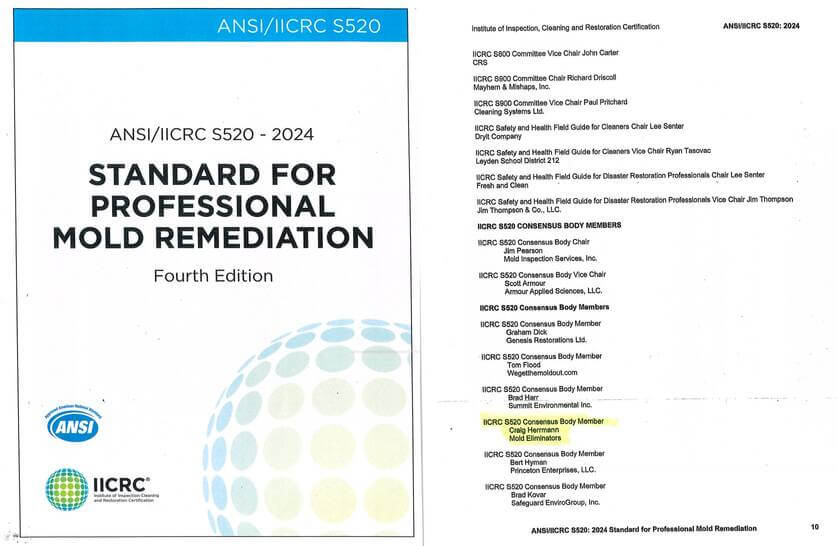
Garage mold done to standard follows a deliberate sequence, the ANSI/IICRC S520 standard our founder Craig Herrmann helped write. The goal is not just to make the stain disappear, it is to remove the moisture source so it never comes back.
- Free on-site inspection. We start with a free inspection of the garage, walls, slab, water heater, and any HVAC equipment, using moisture meters and thermal imaging to find where the water is actually coming from.
- Find and stop the source. A leak, a failed seal, a condensate problem, or slab moisture, the cause is fixed or stopped first. Cleaning before the source is handled is wasted work.
- Containment. We isolate the work area so spores are not pushed into the attached house or HVAC system while we work.
- Removal and cleaning. Affected porous materials are removed and the structure is cleaned to the S520 standard, not painted over.
- Drying. The slab and framing are dried to a documented target with commercial dehumidification, because a garage that feels dry on top can stay damp underneath.
- Independent lab clearance. When we are done, an independent third-party lab verifies the air and surfaces are clean, so you have data, not just our word.
Why Las Vegas homeowners call Mold Eliminators
Written by the standard
Craig Herrmann is IICRC Master Certified and co-authored the ANSI/IICRC S520 mold standard the rest of the industry follows. Your garage is handled by the rulebook. Read more about Craig’s credentials.
Independent verification
We do not grade our own homework. An independent third-party lab confirms the result, and we are anti-upsell: if your garage problem is small, we tell you, and we tell you when you do not need us.
One accountable crew
No subcontractors. Every technician is a certified W-2 employee, with one-hour emergency response, 24/7, across the valley. One crew owns the source, the cleanup, and the verified result.
In business since 1996 and trusted on more than 255 properties, we treat a garage the same way we treat a whole-home job: find the truth, fix the cause, and prove the result. If you would rather just talk it through first, you can reach us directly, with no call center in between. Full mold remediation is available if the inspection turns up more than the garage.
Mold in the garage in Las Vegas, common questions
- Is mold in my garage dangerous to the rest of my house?
- It can affect the house, because the garage shares walls, an attic, and often HVAC pathways with the living space, so spores and musty odors can travel inside. It is not usually a crisis, but it is a reason to find the moisture source and clean it properly rather than leaving it. If you want certainty, a free inspection tells you what is actually there and whether it has spread, and an independent lab can confirm the air is clean once the work is done.
- Can I just clean garage mold with bleach myself?
- For a tiny surface spot on a non-porous surface, sometimes. But bleach treats the stain, not the cause. If the drywall, framing, or slab is still wet from a leak, condensate, or monsoon intrusion, the growth returns, usually wider than before. The real fix is finding and stopping the moisture source first, then cleaning to the S520 standard and drying the structure so mold has nothing left to feed on.
- Why does a garage in the desert get mold at all?
- Las Vegas is dry outdoors, but garages create their own moisture pockets: water heaters and AC condensate lines that drip, slab leaks wicking up through concrete, and wind-driven monsoon rain pushing under the garage door. Add poor ventilation and stored cardboard and fabric, and you have everything mold needs. The desert climate does not prevent it, it just hides it until the staining shows. That is exactly when a free inspection is worth it.
Seeing mold in your garage? Get a straight answer first.
A free, no-pressure on-site inspection finds the real source, no scare tactics and no upsell. One-hour emergency response, 24/7, across the Las Vegas valley. We fix the cause, clean to the S520 standard, and verify the result with an independent lab.