Mold Under the Sink in Las Vegas
If you are seeing mold under the sink, that dark, fuzzy, or slick patch on the cabinet floor or the back wall of the vanity is almost always telling you the same thing: something under there has been wet, quietly, for longer than you knew. The mold is the symptom. The real story is the moisture feeding it.
The good news is that mold under a sink is one of the most common and most fixable problems we see in Las Vegas homes, and it rarely means your whole house is compromised. The bad news is that wiping it away with a spray bottle almost never ends it, because the water source is still there and the spores grow back within days. The honest fix is to find why that cabinet keeps getting wet, dry the structure to standard, and remove the growth so it does not return. That is exactly the work that professional mold remediation is built to do.
What mold under the sink usually means in a Las Vegas home
The cabinet under a kitchen or bathroom sink is a closed, dark, poorly ventilated box sitting directly beneath every water connection in that room. When even a small amount of moisture gets in and cannot escape, it is close to a perfect place for mold to grow. In our experience across the valley, the cause almost always comes down to one of a handful of culprits, and naming the right one is the whole job.
A slow supply or drain leak. The most common source by far. A loose compression nut on a supply line, a worn P-trap washer, a failing garbage disposal seal, or a tired faucet base can weep a few drops a day. You never see standing water, but the cabinet floor stays damp and the particleboard swells, darkens, and grows mold from the inside out.
Condensation on cold pipes. Las Vegas summers are brutal, and many homes run their air conditioning hard. When cold water lines sit inside a hot, humid cabinet, they sweat, and that condensation drips onto the cabinet floor day after day. People often blame a leak when the real cause is simply cold metal meeting warm air.
Hidden moisture from the wall behind the cabinet. Sometimes the water is not coming from the sink at all. A leak in the wall, a connection at the supply stub, or moisture wicking up from a slab-on-grade foundation can keep the back of the cabinet wet while the plumbing under the sink looks fine.
Slab leaks and below-grade moisture. Much of the valley is built on concrete slabs, and a pinhole slab leak under a kitchen can push moisture up into the lowest cabinet long before it shows anywhere else. Concrete holds water far longer than people expect, so a slab issue can feed mold for weeks unseen.
Seasonal intrusion. During monsoon season, roof and exterior wall intrusion can travel through a structure and surface in low, enclosed spaces like a sink cabinet on an exterior wall. Homes that run a swamp cooler also add humidity to the indoor air, which a stagnant cabinet traps and holds.
The reason a diagnosis matters is simple: a condensation problem, a drip leak, and a slab leak each call for a different fix. Guess wrong, scrub the surface, and the mold is back before the month is out. That is why the first step is never a product, it is finding the actual source.
Need help now?
Talk to a Las Vegas expert
In-house certified crews. One-hour emergency response across the valley, 24/7.
Why it matters and how urgent it is
Mold under a sink is usually not an emergency in the way a burst pipe is, but it is not something to leave for later either. It signals ongoing moisture, and ongoing moisture only grows the problem. What starts as a patch on the cabinet floor spreads into the cabinet sides, the toe kick, the subfloor beneath, and eventually the wall cavity behind, where it becomes far harder and more expensive to address.
There is also the air you breathe. A sink cabinet opens and closes many times a day, and every time it does it releases spores and that telltale musty smell into your kitchen or bathroom. For anyone in the home with allergies, asthma, or a weakened immune system, that matters. We do not believe in fear-mongering about mold, and most cases under a sink are manageable, but the honest position is that a known, active moisture source should be found and dried sooner rather than later.
Urgency rises sharply if the moisture is active and spreading: water you can actually see pooling, a slab leak, or intrusion during a monsoon storm. In those cases the structure is getting wet faster than it can dry, and mold colonizes wet organic materials within roughly 24 to 72 hours. If water is actively spreading right now, that is the moment to use our 24/7 emergency response rather than wait. For a contained, slow-growing patch, a scheduled free inspection is the right calm next step.
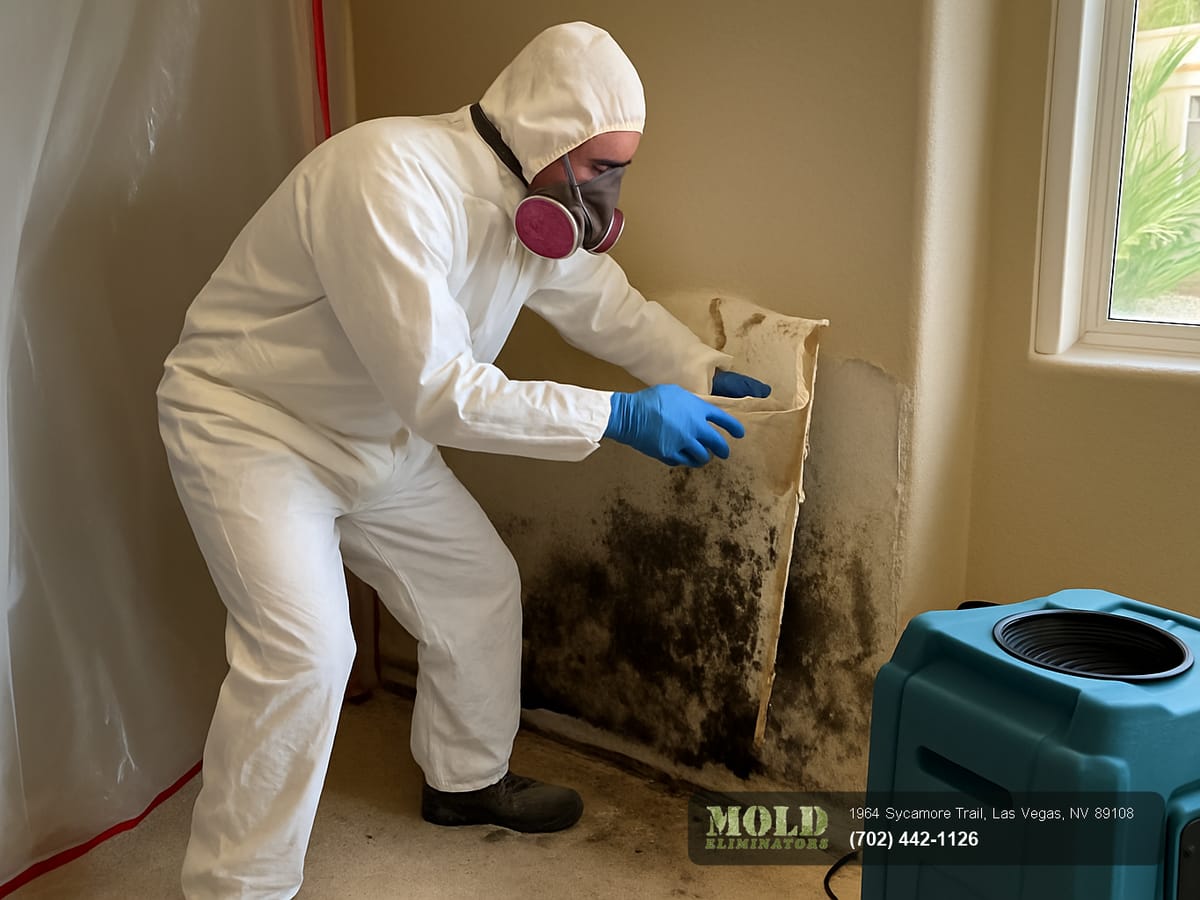 Open vanity cabinet under a bathroom sink showing dark moisture staining on the cabinet floor in a Las Vegas home
What the proper fix involves
Done correctly, fixing mold under a sink follows the same standard as any mold job, scaled to the size of the problem. Mold Eliminators works to the ANSI/IICRC S520 standard, the national rulebook for mold remediation that our founder Craig Herrmann helped write. Here is how the work actually goes.
- Free on-site inspection first. We come out, open the cabinet, and find the real source with moisture meters and, where needed, thermal imaging. The on-site inspection is free. If lab analysis is warranted to confirm the species or clear the air, that is a separate, optional service we explain up front, never a hidden charge.
- Find and stop the source. Drying before the water source is fixed is wasted work. We trace the moisture to the leak, the condensation, the slab, or the intrusion, and make sure it stops, so the problem does not simply return.
- Contain the area. For anything beyond a tiny surface patch, we contain the cabinet and surrounding space so spores are not spread through the rest of the home during removal.
- Remove the growth. Affected porous materials like swollen particleboard cabinet floors are removed, not painted over. Salvageable surfaces are cleaned to standard.
- Dry the structure. The cabinet, subfloor, and any wet wall cavity are dried to a documented target with proper equipment, so no hidden moisture is left to feed regrowth. This is where thorough water damage restoration overlaps with mold work.
- Verify with independent lab clearance. When the scope calls for it, an independent third-party lab confirms the result, so clearance is proven by data, not just declared by the person who did the work.
Why Las Vegas homeowners call Mold Eliminators
Built to the standard
Craig Herrmann is IICRC Master Certified and co-authored the ANSI/IICRC S520 mold standard. Your sink gets the same rulebook a hospital would. Read more about Craig and the S520 standard.
No subcontractors, ever
Every technician is an in-house certified employee, not a hired hand. One accountable crew owns the diagnosis, the fix, and the result, with one-hour emergency response, 24/7, across the valley.
Anti-upsell, lab-verified
We tell you when you do not need us. Verification runs through an independent third-party lab, so clearance is honest data, not a sales pitch. Serving Las Vegas and the valley since 1996, 255+ properties restored.
That is the whole difference. Where others scrub a surface and move on, we find why the cabinet keeps getting wet, fix the source, dry it to standard, and prove the result. If you would rather start with a calm, factual look at what is going on, a free inspection tells you exactly where you stand before any work begins, or you can simply reach us directly.
Mold under the sink in Las Vegas, common questions
- Can I just clean the mold under my sink myself?
- For a small, fresh surface patch on a hard, non-porous surface, careful cleaning can help. But cleaning treats the symptom, not the cause. If the cabinet keeps getting wet from a leak, condensation, or a slab issue, the mold returns within days, and swollen particleboard usually has to be removed, not wiped. The lasting fix is finding and stopping the moisture, which is what our remediation work is built around.
- Is mold under the sink dangerous?
- Most cases under a sink are manageable and do not mean your whole home is compromised. That said, an active moisture source keeps the growth spreading and releases spores and odor into the room every time the cabinet opens, which matters for anyone with allergies or asthma. We do not believe in fear-mongering, so the honest answer is to find the source and dry it sooner rather than later. A free inspection is the calm way to find out where you actually stand.
- Why does the cabinet stay wet even though I do not see a leak?
- In Las Vegas, the cause is often condensation on cold water pipes inside a hot cabinet, or moisture from the wall or a slab behind the cabinet rather than the plumbing under the sink. These are invisible on the surface, which is why we measure with moisture meters and thermal imaging instead of guessing. The same diagnostic care carries through any water damage we dry, so the real source gets named and stopped.
Seeing mold under your sink? Start with a free on-site inspection.
We find the real source, fix it, dry the structure to the S520 standard, and verify the result through an independent lab. No subcontractors, no upsell, one-hour emergency response 24/7 across the Las Vegas valley.