Monsoon Flood Damage in Las Vegas
If you are seeing monsoon flood damage right now, water stains creeping up a wall, a soaked carpet near a doorway, a damp patch on the ceiling, or grit and mud pushed under a door after a storm, take a breath. What you are looking at is almost never just a surface mess. In a Las Vegas home, monsoon water that got inside has usually traveled into places you cannot see, and the real question is not how it looks today but how dry the structure is underneath.
Monsoon flood damage in Las Vegas tends to signal one of a few things: storm water that found a low door or a failed roof seal, a yard that drained toward the house instead of away from it, or a slab that wicked moisture up from saturated ground. The visible stain is the tip of it. The part that decides whether this ends here or becomes a mold problem in three weeks is the moisture sitting inside the drywall, the framing, and the subfloor.
 Monsoon storm water pooling against a Las Vegas home foundation after a summer downpour
What monsoon flood damage usually is in a Las Vegas home
Las Vegas gets very little rain, and then in July, August, and September it gets a season of it all at once. The desert ground is hard and slow to absorb, so a monsoon downpour runs across the surface fast and pools wherever it can. That is why monsoon flood damage here rarely comes from a river overflowing. It comes from water finding a way into a home that was built for heat, not for rain. Diagnosing it honestly means figuring out where the water actually came from, because the source changes the fix.
The most common culprits we see after a storm:
Surface and yard flooding. A driveway, a side yard, or a patio that slopes toward the house sends sheet water under exterior doors, through garage thresholds, and into the ground-floor slab. This is the classic Las Vegas monsoon entry point, and it leaves a wet line across the floor that wicks up baseboards and drywall.
Roof and parapet intrusion. Flat and low-slope desert roofs are not built to shed heavy rain quickly. A clogged scupper, a cracked seam, or a tired roof seal lets monsoon water pond and then push through the ceiling, showing up as a brown ring or a sagging patch indoors.
Hidden water masquerading as monsoon damage. Sometimes the storm is not the whole story. A slab leak, a failing water heater, or condensation from a swamp cooler line can show up at the same time and get blamed on the rain. An honest inspection separates storm intrusion from a plumbing or appliance problem, because fixing the wrong source means the damage comes right back.
Saturated ground and slab wicking. Slab-on-grade construction is everywhere in this valley, and concrete holds water far longer than people expect. When the ground around a foundation stays saturated after a storm, moisture can wick up through the slab for weeks, long after the yard looks dry.
Each of these leaves a different fingerprint, and the only reliable way to tell them apart is to measure the moisture and trace it back to the source, not to guess from the stain.
Need help now?
Talk to a Las Vegas expert
In-house certified crews. One-hour emergency response across the valley, 24/7.
Why it matters, and how urgent this is
There is a clock on flood water, and it is not generous. Mold can begin to colonize wet organic materials within roughly 24 to 48 hours, and most of your home is organic, from paper-faced drywall to wood framing. After about 72 hours the conversation shifts from dry it and save it to remove it and remediate. That window is the whole reason monsoon flood damage is treated as an emergency and not a next-week appointment.
Monsoon water also raises a contamination question that clean tap water does not. Storm runoff that crossed a yard, a street, or a parking lot picks up soil, landscaping chemicals, and bacteria along the way. Water that entered from the ground is often Category 2 or Category 3, which means the porous materials it soaked may need to be removed rather than simply dried. Knowing which category you are dealing with changes the whole plan, and it is not something you can judge by looking.
The Las Vegas climate adds its own twist. Summer heat can drive moisture deeper into cool wall cavities through condensation, and the desert habit of assuming everything air-dries is exactly how a salvageable floor becomes a tear-out. A slab that feels dry on top can stay saturated underneath for weeks. None of that is visible to the eye, which is why fast action and real measurement matter more here, not less. If water is actively spreading right now, the right move is to reach our 24/7 emergency team and stabilize it before it travels further.
 Drying equipment and moisture monitoring set up in a flood-damaged Las Vegas living room
What the proper fix involves
Done correctly, monsoon flood damage is handled to the ANSI/IICRC S520 standard, the national rulebook for assessing and remediating water and mold. That matters because the standard was co-authored by our founder, Craig Herrmann, so the work is not guesswork with a few fans. You can read more about Craig and the S520 standard. Here is how Mold Eliminators handles it, in order.
- Free on-site inspection first. We come out, find where the water actually entered, and map how far it traveled with moisture meters and thermal imaging. The on-site inspection is free, so you get an honest read before any decision.
- Find and stop the source. Storm intrusion, roof seam, slab leak, or swamp cooler line, we confirm the real cause so the same water does not return after we leave.
- Contain the area. We isolate the affected space so moisture and any spores do not spread into clean parts of the home while we work.
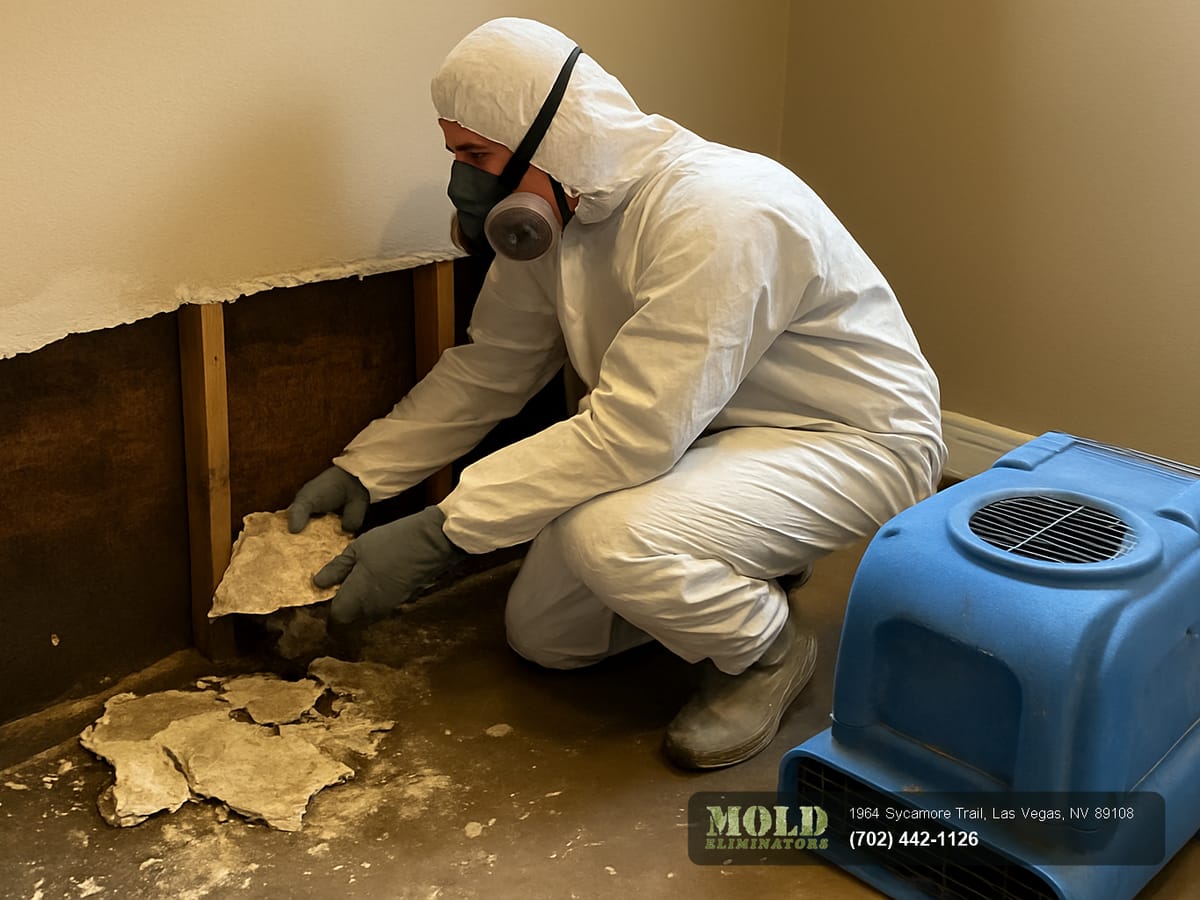
- Remove what cannot be saved. Contaminated or unsalvageable porous materials come out. This is where storm damage overlaps with full flood restoration, contain it, remove what cannot be salvaged, then dry the rest.
- Dry to verified targets. Commercial dehumidification and air movement bring every material back to a documented dry standard, checked daily, never declared by feel.
- Independent lab clearance. An independent third-party lab confirms the result, so dry and clean is proven with data, not just our word.
If you want a full picture of how storm intrusion is handled end to end, our monsoon flood damage service page walks through it in depth.
Why homeowners call Mold Eliminators
No subcontractors
Every technician is a certified W-2 employee of Mold Eliminators. One in-house crew owns the water, the drying, and the mold risk from the first reading to the final cleared result. No handoffs, no finger-pointing.
Independent lab, anti-upsell
Clearance comes from an independent third-party lab, not from us. And because we are anti-upsell, we tell you when you do not need us. We have served 255+ properties since 1996 by being straight with people.
One-hour, 24/7 response
Monsoon water does not wait for business hours, so neither do we. One-hour emergency response, around the clock, across the Las Vegas valley, because the first 24 to 72 hours decide how much you save.
That is the whole difference. Where a franchise drops a few fans and hands your job off, we map the moisture, trace the source, dry to a verified standard, and prove the result with an independent lab. The work is held to the S520 rulebook Craig helped write, from the first reading to the last. You can reach us any time through our contact page, with no call center in between.
Monsoon flood damage in Las Vegas, common questions
- The water dried up on its own. Do I still need anyone?
- Possibly, yes. The surface dries first while the subfloor and framing stay soaked, and a slab can hold moisture for weeks after the yard looks dry. The only way to know is to measure. Our free on-site inspection reads the actual moisture inside your materials, and if a past storm was never verified, a free inspection is the calm, factual way to find out whether anything was left behind. Lab analysis, if you want it, is an optional paid add-on.
- Is monsoon flood water dangerous to clean up myself?
- Storm runoff that crossed a yard or street carries soil and bacteria, so it is often treated as Category 2 or 3 water. Household fans and dry desert air cannot pull moisture out of a soaked wall cavity fast enough to beat mold’s 24-to-72-hour clock, and porous materials touched by contaminated water usually have to be removed, not just dried. If the flooding is more than a quickly caught splash, it is worth a professional flood restoration assessment.
- Will my insurance cover monsoon flood damage?
- It depends on how the water entered and on your policy, and storm intrusion is treated differently from a sudden burst pipe. Either way, the documented moisture map we create from the first visit is exactly what an adjuster wants to see. We log readings, photos, and scope, and work directly with your carrier so a covered water claim does not quietly become a disputed mold claim later. Reach us through our contact page to get started.
Seeing monsoon flood damage? Get a free on-site inspection before mold gets its chance.
Free, no-pressure on-site inspection across the Las Vegas valley, with one-hour emergency response, 24/7. We find the source, dry to verified targets, and confirm the result with an independent lab. Lab testing is an optional paid add-on, never a hidden charge.