Warped Baseboards in Las Vegas
If you are seeing warped baseboards, the trim pulling away from the wall, swelling at the bottom edge, paint flaking, or a soft, spongy feel when you press it, your house is trying to tell you something. Baseboards sit at the lowest point of the wall, right where water collects, so they are usually the first finish to react. Warping there is rarely a cosmetic accident. It almost always means moisture has gotten into the wall base or the floor edge and stayed there long enough to swell the wood.
The good news is that warped baseboards are an early warning, not a verdict. Caught now, the problem is often a contained dry-out and a source repair. Left alone, that same trapped moisture is exactly what mold needs to take hold inside the wall cavity, where you cannot see it until it has spread. This page walks through what warped baseboards usually signal in a Las Vegas home, how urgent it is, and what a proper fix to the national standard actually involves.
What warped baseboards usually mean in a Las Vegas home
Wood and MDF baseboards warp for one reason: they absorbed water and swelled. The real question is never the trim itself. It is where the water came from, because the baseboard is just the visible end of a wet path that runs into the wall and across the floor. In a desert valley like ours, a handful of sources cause the great majority of cases, and they look almost identical at the baseboard.
Hidden plumbing or a slab leak. Slab-on-grade construction is everywhere in the valley, and a supply line failing under the concrete can wick moisture up through the slab edge into the bottom plate and the baseboard with no puddle ever appearing. A warm spot on the floor, a jump in the water bill, or warping along one wall with no obvious spill points this direction.
Air conditioning and condensation. Our cooling season is long and brutal, and a clogged AC condensate line, a sweating supply line, or a failing pan can release a slow, steady drip into a wall or floor for weeks. Baseboards near an air handler closet, a return chase, or an interior wall that carries condensate lines are common spots for this.
Swamp cooler overflow. Evaporative coolers are common on older Las Vegas homes, and a stuck float or a cracked pad line can send water down through the ceiling and into the wall below, surfacing as warped trim far from the roof unit itself.
Monsoon and exterior intrusion. Our summer monsoon dumps heavy rain on ground that cannot absorb it fast. Water finds its way under door thresholds, through stucco cracks, and along the slab edge, soaking the bottom of an exterior wall and warping the baseboard from the back side.
An old water event that was never dried. Sometimes the warping is the late echo of a spill, an overflow, or a leak that was wiped up on the surface months ago but never dried inside the structure. The materials kept reacting, and the trim is finally showing it.
Telling these apart by eye is genuinely hard, which is the whole point of starting with a measured water damage assessment rather than a guess. The fix for a slab leak is nothing like the fix for a condensate drip, and getting the source wrong means the warping comes back.
Need help now?
Talk to a Las Vegas expert
In-house certified crews. One-hour emergency response across the valley, 24/7.
Why it matters and how urgent it is
Here is the part most homeowners do not hear. Warped baseboards mean the structure behind them has been wet long enough for the wood to swell, and wet organic material is exactly what mold colonizes. Mold can begin to grow on damp drywall and framing within roughly 24 to 48 hours of getting wet, and after about 72 hours the conversation shifts from drying and saving to removing and remediating. By the time trim has visibly warped, the moisture has usually been present for a while, so the clock has often already been running.
That does not mean panic. It means do not wait. The danger with a slow source like a slab leak or a condensate drip is that it is undramatic. There is no flood, just a trim board that looks a little off, so it gets ignored for months while moisture keeps feeding whatever is growing inside the wall cavity. The cost difference between catching this early and catching it after the colony has spread through the bottom plate and lower drywall is large.
The honest urgency read is this. If the warping is sudden, spreading, or paired with a musty smell, soft drywall, or visible staining, treat it as active and call now. If water is actively running or the area is clearly wet, our 24/7 emergency response stabilizes the source first and starts structural drying immediately, because every hour of trapped moisture raises the mold risk and the eventual repair scope.
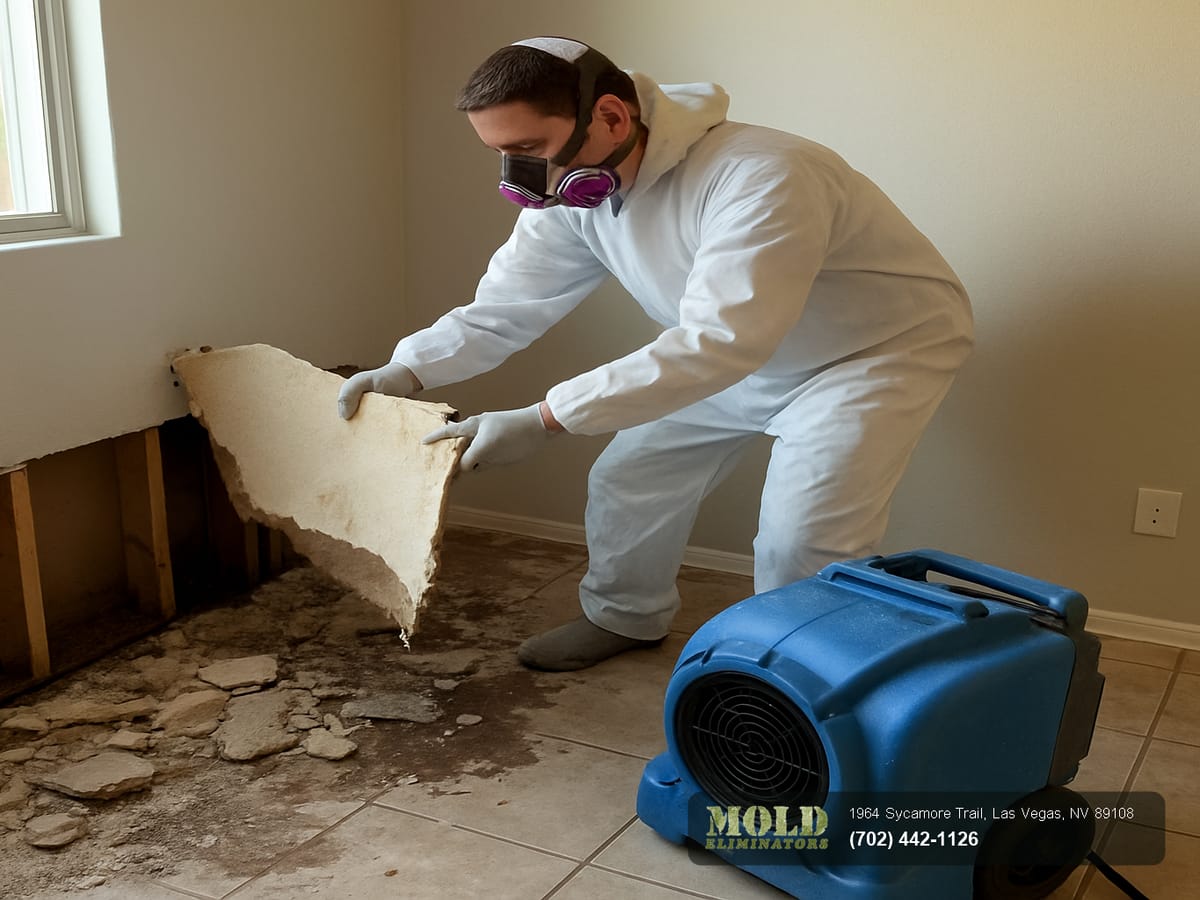 Moisture mapping at the base of a Las Vegas wall where the baseboard has warped
What the proper fix involves, to the S520 standard
A warped baseboard is a symptom, so the right fix treats the cause and the consequence as one job, in the sequence the national mold standard lays out. Our founder, Craig Herrmann, co-authored the ANSI/IICRC S520 standard that governs this work, which means your home is handled by the rulebook rather than by habit. Read more about Craig and the S520 standard.
- Free on-site inspection. We start with a free inspection at your home, reading moisture inside the wall base, floor, and trim with meters and thermal imaging to confirm whether moisture is present and how far it traveled.
- Find the source. Warping never gets fixed until the water stops. We trace it to the actual cause, a slab leak, a condensate line, swamp cooler overflow, or exterior intrusion, so the repair holds.
- Contain the area. If mold is present or likely, we set containment so spores and dust cannot spread to clean parts of the home while the affected materials are opened up.
- Remove what cannot be saved. Swollen baseboard, soaked drywall, and any mold-affected material are removed to a clean margin, following the S520 standard rather than guesswork.
- Dry the structure to verified targets. Commercial dehumidification and controlled air movement bring the framing, slab edge, and remaining materials back to a documented dry standard, measured daily, not declared by feel.
- Independent lab clearance. When the work is done, an independent third-party lab verifies the result, so clearance is confirmed by data from someone who does not work for us, not by the technician who did the job.
Why Las Vegas homeowners call Mold Eliminators for this
No subcontractors
Every technician is a certified W-2 employee of Mold Eliminators, not a hired crew. One in-house team owns the source repair, the drying, and the mold work from the first reading to clearance, so nobody points fingers when something is missed.
Independent lab, anti-upsell
Clearance is verified by an independent third-party lab, and we tell you plainly when you do not need work done. We have authored the standard since 1996 and have no reason to inflate a job. If your baseboard just needs a dry-out, that is what we will say.
1-hour response, 24/7
When water is active, speed decides how much you save. We respond within one hour, day or night, anywhere across the valley, because the difference between drying and demolishing is often measured in hours, not days.
That is the whole difference. Where a franchise drops a few fans and hands your job off, we find the source, dry to a verified standard, and prove the result with an independent lab, the same way our full water damage restoration is held to the rulebook from the first reading to clearance. The free inspection is the calm, factual first step. Reach us directly, with no call center in between.
Warped baseboards in Las Vegas, common questions
- Do warped baseboards always mean mold?
- No, but they always mean moisture, and moisture is what mold needs. Warping tells us water reached the wall base and stayed long enough to swell the trim. Whether mold has started depends on how long the area has been wet and how warm it is inside the cavity. The only way to know is to measure, which is exactly what the free on-site inspection does before any work is proposed.
- Could it just be from mopping or normal humidity?
- A single splash rarely warps a baseboard, and Las Vegas air is usually too dry on its own to do it. Persistent warping points to a steady moisture source behind or beneath the trim, often a slab leak, a condensate line, or swamp cooler overflow. If we read the wall base and the materials are genuinely dry, we will tell you so. Our anti-upsell approach means no manufactured emergency.
- How fast do I need to act?
- If the warping is sudden, spreading, or paired with a musty smell or soft drywall, treat it as active and call now, because mold can colonize damp materials within 24 to 72 hours. If anything is actively wet, our 24/7 emergency team stabilizes the source and begins structural drying right away to limit the damage.
Warped baseboards? Find the source before it becomes mold.
Start with a free on-site inspection from the team whose founder co-authored the national mold standard. We measure the moisture, trace the source, and verify the result with an independent lab. One-hour emergency response, 24/7, across the Las Vegas valley.