Water in the Walls in Las Vegas
If you are seeing water in the walls, a damp patch spreading across the drywall, a bubble of paint, a brown ring, or a baseboard that feels soft to the touch, your home is telling you that water is moving somewhere it should not be. It is unsettling, and it is also a signal worth taking seriously, because water inside a wall cavity almost never stays put. It travels down studs, soaks into the bottom plate, and feeds the one thing every Las Vegas homeowner wants to avoid: hidden mold.
The good news is that what you are looking at is a symptom, not a verdict. A wet wall can mean several very different things, and the right next step depends entirely on which one you have. This page walks you through what water in the walls usually signals in a Las Vegas home, how urgent it is, and what a proper fix actually involves, so you can act with information instead of panic. When you are ready, our free inspection finds the source before anyone talks about repairs.
What water in the walls usually means in a Las Vegas home
Visible moisture on a wall is the surface symptom of a source you cannot see, and in the desert the likely sources are a short, specific list. Narrowing it down is the whole job, because the fix for a slab leak is nothing like the fix for a sweating air conditioner.
A hidden plumbing or slab leak. A pinhole in a copper line, a failed fitting inside the wall, or a slab leak under the foundation can push water up into the bottom of a wall for weeks before it shows. Slab-on-grade construction is everywhere in the valley, and concrete holds and wicks water far longer than people expect, so a wet wall low to the floor with no obvious source above it often points underground.
Air conditioning condensation. Las Vegas runs its AC for half the year, and a clogged condensate drain line, a rusted drain pan, or an attic air handler can send a steady drip down inside a wall. The wall looks wet, but the culprit is the cooling system, not a pipe.
Swamp cooler overflow. Evaporative coolers are common on older Las Vegas homes, and a stuck float, an overflowing pan, or a leaking supply line on a roof unit can run water straight down the wall it sits above. This is a classic desert source that an out-of-town company often misses entirely.
Monsoon and storm intrusion. Our summer monsoon delivers sudden, hard rain onto homes built for dryness. Failed roof flashing, tired stucco, a window seal that gave out, or poor drainage can let storm water in through the building envelope and track down inside the walls.
A water heater, appliance, or fixture line. A weeping water heater in a closet, a dishwasher or washing machine line, or a failing shower pan can all release water that finds its way into the adjoining wall.
Any of these can already be feeding mold inside the cavity. Once water sits against paper-faced drywall and wood framing, growth can start within a day or two, which is why diagnosing the source and checking what is happening behind the surface go together. If the wall has been wet for a while, the real question may already be mold behind the walls, not just the leak that caused it.
Need help now?
Talk to a Las Vegas expert
In-house certified crews. One-hour emergency response across the valley, 24/7.
Why it matters and how urgent it is
Water in the walls is time-sensitive, and the clock is not generous. Mold can begin to colonize wet drywall and framing within roughly 24 to 48 hours, and after about 72 hours the conversation usually shifts from drying the material and saving it to removing and remediating it. Most of your wall is organic, from the paper facing on the drywall to the wood studs behind it, and that is exactly what mold feeds on once it gets wet.
There is structural risk too. Prolonged moisture rots framing, corrodes fasteners, swells and crumbles drywall, and can quietly travel into adjoining rooms through the bottom plate. The Las Vegas climate adds a cruel twist: our extreme summer heat can drive moisture deeper into cool wall cavities through condensation, and the dramatic day-to-night temperature swings make the comforting idea that it will just air-dry a genuinely dangerous assumption. A wall that feels dry on the surface can stay soaked inside for weeks.
So how urgent is it? If water is actively spreading right now, if a wall is bulging or sagging, or if you smell a strong musty odor, treat it as an emergency and call our 24/7 emergency line so the source can be stabilized and drying can start immediately. If it is a slow, intermittent stain with no active flow, you still want it inspected within days, not weeks, because that hidden window is where a manageable leak becomes a remediation job.
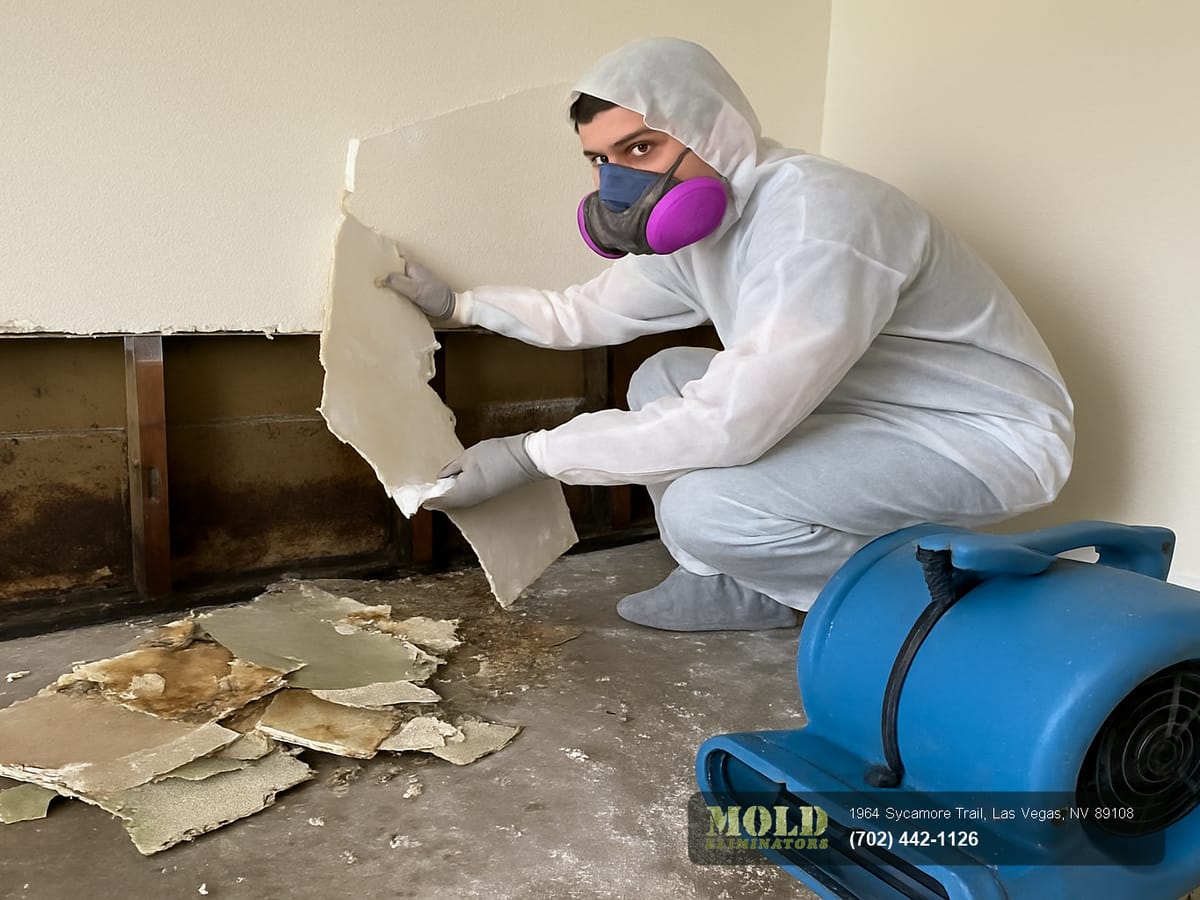 Technician using a moisture meter to trace water inside a Las Vegas wall cavity
What the proper fix actually involves
Done to the ANSI/IICRC S520 standard, fixing water in the walls is a measured sequence, not a guess with a few fans. Our founder, Craig Herrmann, co-authored that national standard, so this is the rulebook we wrote, applied to your home. You can read more about Craig and the S520 standard.
- Free on-site inspection first. We come out, look, and listen before anyone quotes a repair. The free inspection is where the honest diagnosis happens, no obligation attached.
- Find the source. Using moisture meters and thermal imaging, we trace exactly where the water is coming from and how far it traveled inside the wall, so the fix targets the real cause, not just the stain.
- Contain the area. If mold is involved, we seal off the work zone so spores cannot spread to clean parts of the home while the wall is open.
- Remove what cannot be saved. Soaked, contaminated, or moldy materials are removed properly. Drywall and insulation that have crossed the line are taken out, not painted over.
- Dry to verified targets. Commercial dehumidification and controlled air movement bring the framing and remaining materials back to a documented dry standard, measured daily, never declared by feel.
- Independent lab clearance. When mold was present, an independent third-party lab verifies the result. You get data showing the area is clean, not our word for it.
Why Las Vegas homeowners call Mold Eliminators
No subcontractors
Every technician is a certified W-2 employee. One in-house crew owns the leak, the drying, and the mold risk from the first reading to the final clearance, so nobody points fingers when something was missed.
Independent lab, not our say-so
Clearance is verified by an independent third-party lab, never by the same hands that did the work. When we tell you the wall is clean, you have data that proves it.
Anti-upsell, since 1996
We tell you when you do not need us. With one-hour emergency response, 24/7, and more than 255 properties handled, we are built to fix the problem honestly, not to pad an invoice.
That is the difference. Where an out-of-town franchise might miss a swamp cooler or a slab leak entirely and simply sell a package, we diagnose the desert-specific cause, fix it to the S520 standard, and prove the result. If the water has already done damage beyond the wall, our full water damage restoration team handles the drying and rebuild under one roof, with one chain of responsibility.
Water in the walls in Las Vegas, common questions
- Is water in my walls always a mold problem?
- Not always, but it is always a mold risk. If the water has been there more than a day or two, growth has likely started inside the cavity, which is why we check behind the surface during the inspection. Catch it fast and dry it to standard, and you can often stop mold behind the walls before it takes hold. Leave it, and a leak quietly becomes a remediation.
- The wall is wet but I cannot find a leak. What could it be?
- In Las Vegas the hidden culprits are usually an AC condensate line, a swamp cooler overflow on the roof, or a slab leak under the foundation. None of these are visible from inside the room, which is exactly why a measured inspection with moisture meters and thermal imaging matters. We trace the source rather than guess at it.
- How fast do I need to act?
- Quickly. Mold can begin colonizing wet drywall and framing within 24 to 72 hours, so active water is an emergency and a slow stain still needs attention within days. If a wall is actively wet, bulging, or smells musty, our 24/7 emergency response stabilizes it the same hour, or you can simply reach us directly with no call center in between.
Seeing water in the walls? Get a free inspection before mold gets its chance.
A free, no-pressure on-site inspection finds the real source, and independent lab clearance proves the fix. One-hour emergency response, 24/7, across the Las Vegas valley. Lab testing is available as a paid add-on when you want it.