Wet Carpet in Las Vegas
If you are seeing wet carpet right now, your first instinct is probably to grab a towel and figure out where the water came from. That instinct is right, but the carpet itself is rarely the real story. Wet carpet is a symptom. It is the visible edge of moisture that has almost certainly already moved into the pad beneath it and, very often, into the subfloor and the bottom plate of the wall. In a Las Vegas home, the cause and the urgency depend heavily on where the water came from, and that is the question worth answering before you decide what to do next.
Here is the part most homeowners do not hear until it is too late. Carpet is the slowest part of the assembly to dry and the fastest to hide a problem. The fibers can feel only slightly damp on top while the pad underneath stays saturated for days, and that trapped moisture is exactly what mold needs to bloom. So the calm, correct move is not to panic and not to ignore it. It is to find the source, measure how far the water actually traveled, and dry the structure to a real standard before spores get their chance.
What wet carpet usually means in a Las Vegas home
Wet carpet has a handful of common causes here, and the desert gives several of them a particular flavor. Knowing which one you are dealing with changes both the urgency and the fix, so it is worth diagnosing honestly rather than guessing.
An appliance or plumbing leak. A water heater that let go, a washing machine supply line, a dishwasher, or a slow connection leak under a sink can wick water out across a floor and into adjacent carpet long before you notice a puddle. This is clean water at first, but it stops being clean the longer it sits.
A slab leak. Slab-on-grade construction is extremely common in Las Vegas, and a pinhole leak in a pressurized line running through or under the concrete can push moisture up through the slab and into the carpet pad. Slab leaks are sneaky because the wet spot can appear far from the actual break, and the slab holds water far longer than people expect.
AC condensation and a backed-up drain line. Our air conditioners run hard for months, and a clogged condensate drain line or a failed overflow pan can quietly release water that ends up in a hallway or closet carpet near the air handler. This is one of the most common warm-season culprits in the valley.
Swamp cooler overflow. Many older Las Vegas homes still run evaporative coolers. A stuck float, an overflowing reservoir, or a leak in the supply line can send water down through a ceiling or along a wall and into the carpet below.
Monsoon intrusion. During monsoon season, a few inches of fast rain can find a low threshold, a failed door sweep, or a grading problem and push water inside, soaking carpet near an exterior wall or a sliding door.
The reason the source matters is that it tells you whether you have clean water, gray water, or contaminated water, and how fast it needs to come out. A clean appliance line caught quickly is a very different job from a monsoon flood or a slow leak that has been feeding a wall for a week.
Need help now?
Talk to a Las Vegas expert
In-house certified crews. One-hour emergency response across the valley, 24/7.
Why it matters and how urgent it really is
There is a clock on wet carpet, and it is not generous. Mold can begin to colonize wet organic materials within roughly 24 to 48 hours, and most of the assembly under your feet is organic, from the paper face of the drywall at the base of the wall to the wood subfloor. After about 72 hours, the conversation shifts from drying and saving the materials to removing and remediating them. That window is the whole reason wet carpet is treated as an emergency rather than a weekend chore.
The desert adds its own wrinkles. People assume our dry air will simply evaporate the problem, but a soaked carpet pad and a wet subfloor do not air-dry from the top down fast enough to beat that 24 to 72 hour clock. Worse, in summer the heat can drive moisture deeper into cool wall cavities through condensation, and a concrete slab that feels dry on the surface can stay saturated underneath for weeks. None of this is visible to the eye, which is exactly why it needs to be measured.
If the water is still spreading, or it came from a sewage backup or a ground-level flood, treat it as urgent and call rather than wait. Our 24/7 emergency response exists for exactly this, because the faster a controlled drying environment goes in, the more material you save and the lower the mold risk drops.
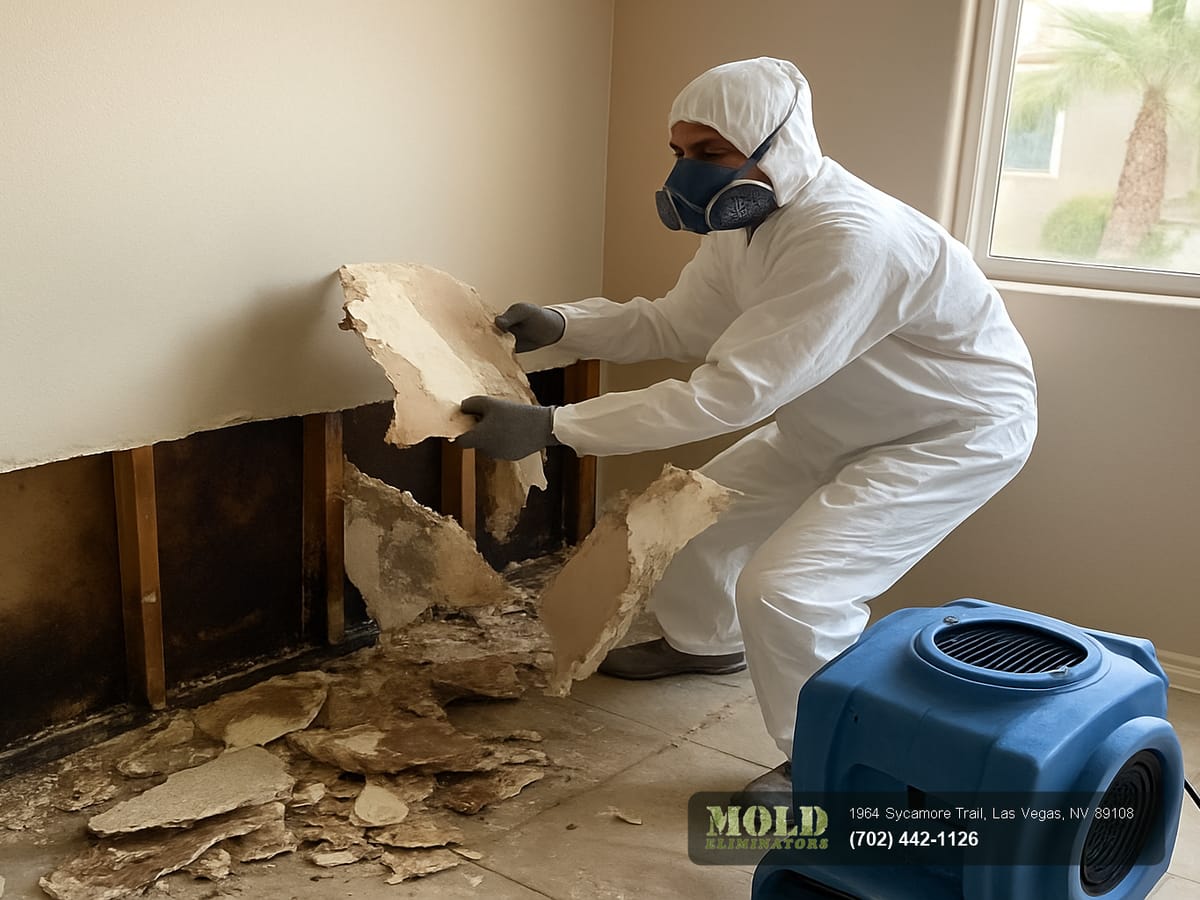 Technician lifting wet carpet to check the saturated pad and subfloor in a Las Vegas home
What the proper fix actually involves
Drying wet carpet correctly is not a matter of pointing a fan at it and hoping. It follows the same engineering discipline as full carpet water damage recovery, measured against the ANSI/IICRC S520 standard that our founder Craig Herrmann helped author. Here is how Mold Eliminators handles it, in order.
- Free on-site inspection first. We come out, find where the water is actually coming from, and measure how far it traveled with moisture meters and thermal imaging. The inspection is free, so you get real answers before any decision about scope or cost.
- Stop and identify the source. Drying carpet over an active leak is wasted effort. We confirm the source, whether it is a slab leak, a condensate line, or an appliance, so the problem actually ends.
- Contain the affected area. If there is any contamination or mold risk, we contain the space so spores and moisture do not spread to dry parts of the home while we work.
- Remove what cannot be saved. Carpet pad that has been saturated by gray or contaminated water usually has to go. Clean-water carpet caught early can often be saved. We tell you honestly which one you are in rather than tearing out everything by default.
- Dry to verified targets. Commercial dehumidifiers and air movers dry the carpet, pad, subfloor, and wall base to a documented dry standard, with daily moisture readings driving the schedule instead of the calendar.
- Independent lab clearance. When mold was involved, an independent third-party lab verifies the result, so dry and clean are proven with data, not declared by the person who did the work.
Why Las Vegas homeowners call us for this
Certified to the standard
Craig Herrmann is IICRC Master Certified and co-authored the ANSI/IICRC S520 standard, working in Las Vegas since 1996 across 255 plus properties. Your home is dried by the rulebook, not by feel. Read more about Craig and the S520 standard.
No subcontractors
Every technician is an in-house certified employee, with one-hour emergency response, 24/7, across the valley. One crew owns the source, the drying, and the mold risk from the first reading to the verified finish.
Anti-upsell, lab-verified
We tell you when carpet can be saved and when it cannot, and an independent third-party lab confirms the result. No padded bills, no fear-selling, no tear-out you did not need.
That is the whole difference. Where a franchise drops a few fans and hands your job off, we find the source, dry to a verified standard, and document the result. If you would rather talk it through first, you can always reach us directly, with no call center in between.
Wet carpet in Las Vegas, common questions
- My carpet feels almost dry on top. Is it really a problem?
- Quite possibly, yes. Carpet fibers dry from the top first while the pad underneath stays saturated, and the subfloor and wall base can hold water you cannot feel. The only way to know is to measure the materials, not the surface. If the source was clean water and it is caught within a day or so, the carpet can often be saved with proper drying. The risk is assuming it is dry when the assembly beneath it is not.
- Will the dry desert air just dry it out on its own?
- Not fast enough to beat mold. Our dry air helps surfaces, but a soaked carpet pad, a wet subfloor, or a saturated concrete slab does not release water from the inside quickly, and summer heat can actually push moisture deeper into cool wall cavities. Without dehumidification and daily moisture readings, you are guessing, and guessing is how a small wet spot becomes a mold job. Proper carpet water damage drying removes the moisture before spores can colonize.
- Is the inspection really free, and what about testing?
- The on-site inspection is free. We come out, find the source, and measure how far the water traveled at no cost to you, so you get honest answers before deciding anything. If laboratory analysis is needed to confirm mold, that lab work is a separate paid step using an independent third-party lab, and we will tell you up front whether it is warranted. We do not push tests you do not need.
Seeing wet carpet right now? Start with a free on-site inspection.
We find the source, measure the moisture, and tell you honestly what can be saved. One-hour emergency response, 24/7, across the Las Vegas valley. No subcontractors, no upsell.