Flood Restoration in North Las Vegas, NV
North Las Vegas, NV 89030–89086
A pipe lets go in an Aliante two-story at 2 a.m., a monsoon cell dumps an inch on Craig Ranch in twenty minutes, or an aging supply line in central North Las Vegas finally fails behind a kitchen wall. The water is dramatic, but the real risk starts after it stops moving. Flood restoration in North Las Vegas is the work of getting that water out, drying the structure to a measured standard, and proving mold never gets the wet surface it needs to grow.
Mold Eliminators handles flood restoration for North Las Vegas to the ANSI/IICRC S520 standard, the national mold standard our founder Craig Herrmann helped write. We are based minutes away at 1964 Sycamore Trail, so the same in-house, W-2 certified crew that maps the water also dries it and verifies the result. No subcontractors, no handoffs, no call center. This is the service pillar for flood restoration applied specifically to the neighborhoods, plumbing, and weather of North Las Vegas.
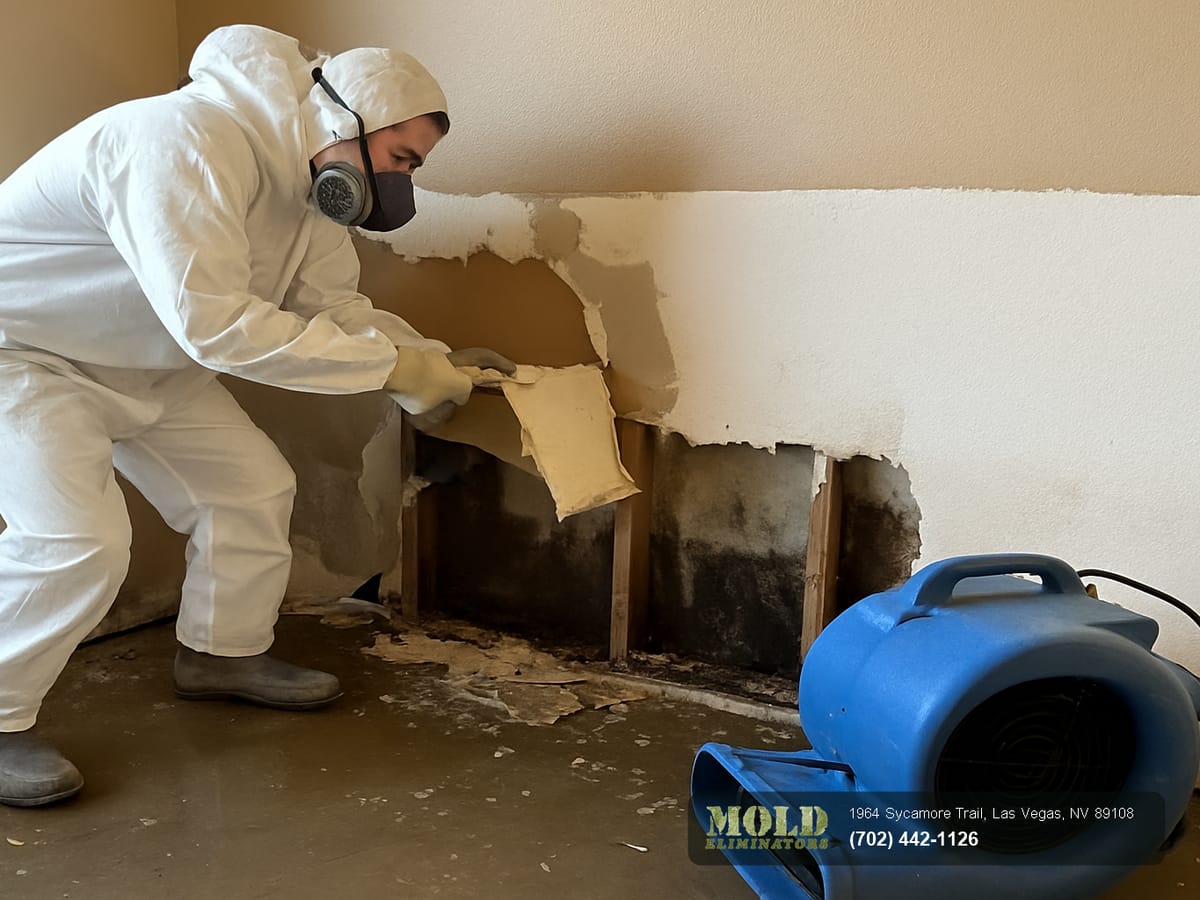
 Flood restoration drying equipment set up in a North Las Vegas home
How flooding shows up in North Las Vegas
North Las Vegas is not one kind of housing stock, and that is why a city-swap template fails here. The newer master-planned builds out in Aliante, along the Tropical Parkway corridor, and up toward the Centennial corridor went up fast during the boom years, and we see the predictable result: slab leaks and pinhole copper failures that release water under the slab and inside walls for days before anyone notices the bill or the buckled floor. A pinhole leak in a second-floor bathroom line in Aliante can saturate a ceiling, an interior wall, and a downstairs subfloor before a single drop reaches a visible surface.
Central and older North Las Vegas, much of the 89030 core off Las Vegas Boulevard North and the established streets around Craig Road, tells the opposite story. The plumbing there has aged, galvanized and early copper supply lines corrode and split, sewer laterals fail, and a slow supply-line leak behind a wall can feed mold for weeks. Eldorado and Craig Ranch sit in between, with a mix of build eras and a mix of failure modes to match.
Then there is the weather. North Las Vegas does not flood gently. Our summer monsoon drops a lot of water in a short burst, and the wash zones along the Las Vegas Wash channel that runoff fast. Homes near those wash corridors, and low-lying yards and garages across the Centennial and Tropical Parkway areas, take in storm water and street runoff that is rarely clean. That difference, clean supply-line water versus contaminated storm or ground water, decides the entire restoration plan.
Need help now?
Talk to a Las Vegas expert
In-house certified crews. One-hour emergency response across the valley, 24/7.
The first 24 to 72 hours decide the outcome
Mold can begin colonizing wet organic materials, and most of a North Las Vegas home is organic, from paper-faced drywall to wood framing, within roughly 24–48 hours of getting wet. After about 72 hours the conversation shifts from dry it and save it to remove it and remediate. That clock is the whole reason flood restoration is an emergency response, not a scheduled appointment.
Being local is the practical advantage here. We are minutes from Aliante, Eldorado, Craig Ranch, and the central North Las Vegas neighborhoods, so when a slab leak or a monsoon flood is actively spreading, our 24/7 emergency response can have a crew on site fast, often inside the hour, to stabilize the water before it travels further into the structure. A flood left overnight because tomorrow seemed fine can turn a salvageable subfloor into a tear-out.
The desert adds its own complications to that window. Slab-on-grade construction is the norm across North Las Vegas, and concrete slabs hold water far longer than people expect, a slab that feels dry on top can stay saturated underneath for weeks. Summer heat can drive moisture deeper into cooler wall cavities through condensation, and the dry desert air fools people into assuming a flood will simply air out. It will not, not at the depth and speed that beats mold. That is why drying has to be measured, not guessed.
 Technician taking moisture readings during flood restoration in North Las Vegas
Our flood restoration process, to the S520 standard
Flood restoration done to standard follows a deliberate sequence, the same one anchored in the ANSI/IICRC S520 standard Craig Herrmann co-authored. You can read more about Craig and the S520 standard. Every step is measured and documented, so dry means proven dry.
- Assessment and water category. We first determine whether you have clean supply-line water, contaminated storm or ground water from a wash-zone flood, or sewage. The category drives everything that follows.
- Extraction. Standing and absorbed water is physically extracted, because pulling water out is far faster than evaporating it and it protects the materials underneath.
- Moisture mapping. Using meters and thermal imaging, we map exactly how far the water traveled, including under the slab, and set a documented dry target for each material.
- Containment and removal. Where contaminated water or hidden mold is involved, porous materials that cannot be salvaged are contained and removed rather than dried in place.
- Structural drying. Commercial dehumidifiers, air movers, and temperature control work together to pull moisture out of the structure as fast as the materials can safely release it.
- Daily monitoring. Readings are logged every day the equipment runs, so the data drives the schedule, not the calendar, and the drying stops the moment targets are met.
- Verification. When mold is a question, samples go to an independent third-party lab so the all-clear is confirmed by data, not by the crew that did the work.
Why local, in-house, and an independent lab matter here
Local response, fast
Our HQ is minutes from Aliante, Craig Ranch, Eldorado, and central North Las Vegas. When a slab leak or monsoon flood is spreading, response time is the difference between drying and demolition, and we are already nearby with one-hour emergency response, 24/7.
No subcontractors
Every technician is a certified W-2 employee. One in-house crew owns the water, the drying, and the mold risk from the first reading to the final verified-dry target. No franchise handoff, no finger-pointing when something gets missed.
Independent lab
When mold verification is warranted, samples go to an independent third-party lab, billed at cost, not to an in-house bench with a reason to find work. Anti-upsell by design: we tell you when you do not need us.
That is the whole difference. Where a national franchise drops a few fans and hands your North Las Vegas job to whichever crew is free, we map the moisture, dry to a documented S520 standard, and verify the result. The free offer is an on-site inspection, you can book a free inspection with no pressure, and if lab analysis is warranted, samples go to an independent third-party lab billed at cost. This page is the local arm of our valley-wide flood restoration service, and you can see the full North Las Vegas picture on our North Las Vegas service area hub.
Flood restoration in North Las Vegas, common questions
- How fast can you reach my North Las Vegas home?
- We are based at 1964 Sycamore Trail, minutes from Aliante, Eldorado, Craig Ranch, and the central North Las Vegas neighborhoods. For an active flood our 24/7 emergency response targets one hour, because the first 24–72 hours decide whether materials are saved or torn out. Call (702) 442-1126 and we stabilize the water first.
- Is the water from my flood clean or contaminated?
- It depends on the source, and in North Las Vegas it varies by neighborhood. A burst supply line or pinhole copper failure in an Aliante home is usually clean water. Storm runoff from a monsoon cell along the Las Vegas Wash zones, or a sewer-line backup in older central North Las Vegas, is contaminated and changes the plan. We determine the category before we set a single fan, then handle it as flood restoration or specialized cleanup accordingly.
- Do I get a free inspection, and what about lab testing?
- Yes. The on-site inspection is free with no pressure, and you can book a free inspection any time. Lab analysis is a separate paid step: if it is warranted, samples go to an independent third-party lab and you are billed at cost. We are anti-upsell, so we only recommend testing when the situation actually calls for it. You can also reach us directly, no call center in between.
Flooded in North Las Vegas? Dry it right before mold gets its chance.
Free, no-pressure on-site inspection. One-hour emergency response, 24/7, minutes from Aliante, Craig Ranch, Eldorado, and central North Las Vegas. We dry to verified S520 targets and prove it, so the water problem ends here.