Mold and Indoor Air Quality
You can scrub a surface clean and still feel that something is off the moment you walk in: a heaviness in the air, a faint musty edge near the closet, a stuffiness that no amount of opening windows seems to clear. That feeling is real, and it has a name. Mold and indoor air quality are tied together at the level of physics, because the same spores that grow on a damp surface also drift through the air you breathe all day.
This guide explains, in plain terms, how mold affects indoor air quality: where spores come from, why some people in a household react while others do not, and what air sampling can and cannot tell you. It is not medical advice, and it is not meant to scare you. It is the calm, technical picture we wish every homeowner had before they decide whether they actually have a problem worth acting on. At Mold Eliminators, we would rather hand you the facts and tell you the air is fine than sell you a job you do not need.
What indoor air quality really means
Indoor air quality, often shortened to IAQ, describes the condition of the air inside a building and how it affects the comfort and health of the people in it. It is the sum of many things at once: temperature, humidity, ventilation, dust, chemical vapors, and biological particles like pollen, bacteria, and mold spores. Mold is only one piece of that picture, but it is a piece that behaves differently from the rest, because mold is alive and it grows. A chemical smell fades as the source is removed. A mold problem feeds on moisture and gets worse until the moisture is gone.
That distinction matters because it changes how you fix the air. You cannot filter your way out of an active mold colony any more than you can vacuum your way out of a leak. The particles keep coming as long as the source keeps growing. Good indoor air quality where mold is concerned always comes back to one thing: controlling moisture so the mold has nothing to feed on. This is the same principle behind every honest mold remediation job. Find the water, stop it, remove what grew, and the air follows.
In the desert this surprises people, because Las Vegas is famously dry. But our homes are full of hidden water: swamp coolers that add humidity by design, slab leaks under concrete, condensation inside walls during the summer heat, and monsoon intrusion that soaks a structure in an afternoon. Dry outside does not mean dry inside, and the air in a closed-up house tells a very different story than the patio thermometer.
Need help now?
Talk to a Las Vegas expert
In-house certified crews. One-hour emergency response across the valley, 24/7.
How mold gets into the air you breathe
Mold reproduces by releasing spores: microscopic, lightweight particles built to travel. A single colony can release millions of them, and because they are so small they stay suspended in the air for long stretches, riding the smallest air currents from a closet or a wall cavity into the rooms where you actually spend your time. This is the core reason mold and indoor air quality are inseparable. The mold does not have to be visible, or even in the same room, to be part of the air you are breathing.
Spores are not the only thing a colony puts into the air. Growing mold also releases microbial volatile organic compounds, the gases responsible for that distinctive earthy, musty odor. That smell is not just unpleasant, it is information: it is often the first and only sign that active growth is happening somewhere you cannot see. When a structure stays damp, the spore count and these compounds build up in the indoor air far above what you would find outside, which is exactly backward from a healthy building, where indoor air should be cleaner than the air outdoors.
The amount that reaches you depends on the size of the colony, how disturbed it is, and how the air moves through the house. Forced-air heating and cooling can take a hidden problem in one room and distribute its spores through every vent in the home. That is why a musty smell in one corner can leave the whole house feeling stale, and why fixing the air means fixing the source, not masking the symptom.
 Air sampling pump set up to measure airborne mold spore levels in a Las Vegas living room
Why some people react and others do not
One of the most common questions we hear is why one person in a household feels miserable while everyone else seems fine. The honest answer is that sensitivity to airborne mold varies enormously from person to person, and that variation is normal. We are not doctors, and nothing here is a diagnosis, but the general patterns are well documented and worth understanding so you can make a calm, informed decision.
Mold spores and the compounds that come with them are irritants and, for some people, allergens. Many people can share a space with elevated spore levels and notice very little. Others are far more reactive to the same air. The groups most often described as sensitive include infants and young children, older adults, people with asthma or other respiratory conditions, people with allergies, and anyone whose immune system is already compromised. For these groups, air that a healthy adult shrugs off can be genuinely uncomfortable.
This is also why you should be wary of anyone who tells you mold will harm everyone equally, or who uses a single symptom to sell you a large job. Symptoms have many causes, and only a physician can connect a specific health complaint to a specific exposure. What we can do is measure the air objectively and tell you what is actually in it. If a sensitive family member is reacting and you suspect the air, the right sequence is to talk to their doctor about the symptoms and, separately, have the air assessed so you are working from facts rather than fear. A free inspection is a no-pressure way to start that second half.
Air sampling: what it measures and what it cannot
You cannot improve air you have not measured, and you cannot prove the air is clean on a feeling. Air sampling is the tool that turns a vague suspicion into a number. The idea is straightforward: a calibrated pump pulls a known volume of air through a collection device, capturing the spores suspended in it so they can be counted and identified under a microscope at a lab. Done properly, it gives you an objective read on what is actually floating in your indoor air.
Here is the part too many companies blur: the on-site inspection that finds moisture and visible growth is the foundation, and for property owners that inspection is free. If the inspection shows that laboratory analysis is warranted, samples are collected and sent to an independent third-party lab, and that lab work is a paid add-on billed at cost. We will not pretend a paid lab report is free, and we will not push a test you do not need. To understand the full picture of how sampling fits a structured workup, see our pages on air quality and mold testing and the laboratory side of mold testing.
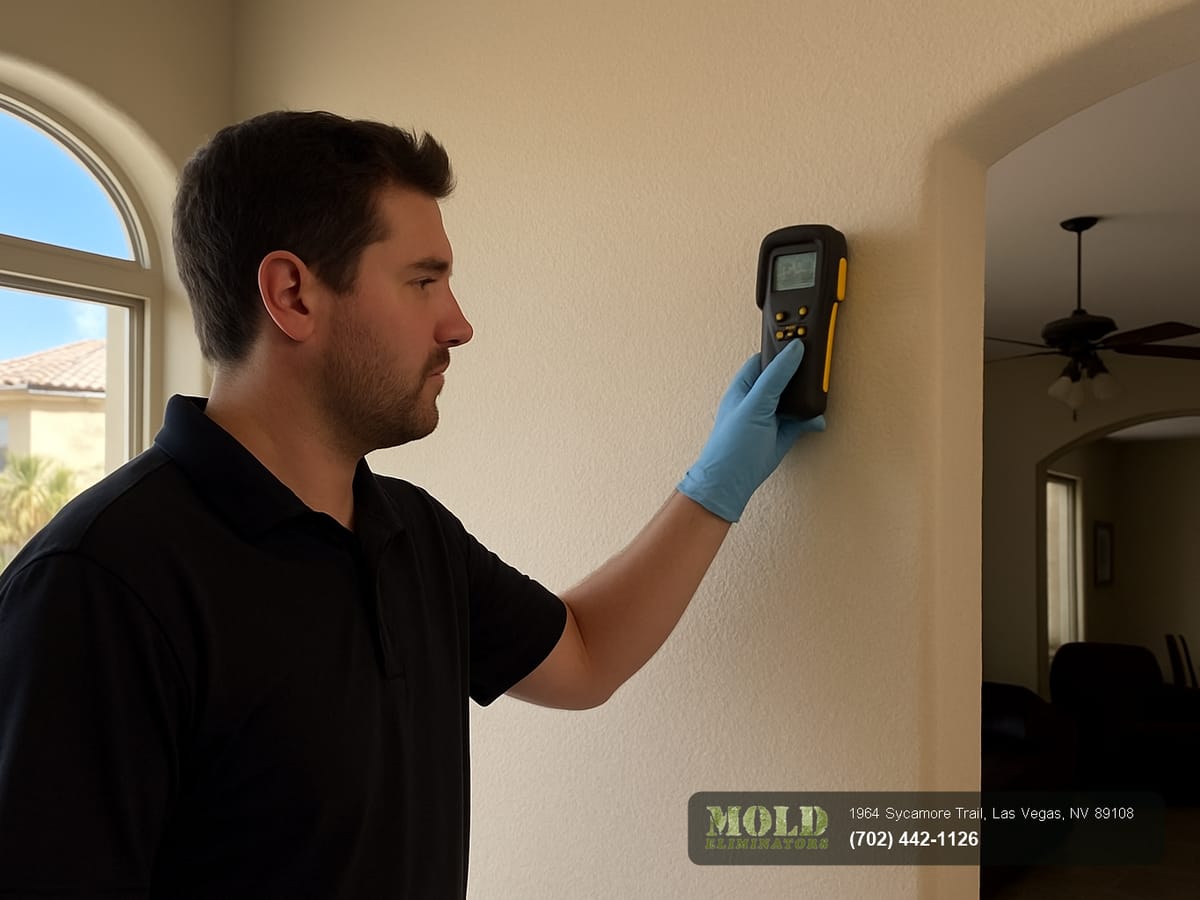 Certified technician reviewing moisture and air sampling data against the IICRC S520 standard
Why the standard behind the test matters
Anyone can buy an air pump. What separates a meaningful result from a meaningless one is whether the person interpreting it works to a recognized standard. Mold assessment in this industry is governed by the ANSI/IICRC S520 standard, and our founder Craig Herrmann did not just read it, he helped write it as a co-author of the 4th Edition, published in 2024.
That matters for your air in a very practical way. The standard defines what a proper assessment looks like: identify the moisture source, define the conditions, sample and document objectively, and verify the result rather than declaring it. When the person reading your air sampling holds the IICRC Master Certified Flood Expert credential and helped author the rulebook, you are getting interpretation grounded in the standard itself, not a sales pitch dressed up as science. You can read more about Craig’s credentials and what the S520 standard means for your home.
It also shapes how we behave when the numbers come back clean. Working to the standard means we are just as willing to tell you the air is fine as to tell you it is not. We have been doing this in Las Vegas since 1996, across 255 plus properties, with no subcontractors and in-house W-2 certified crews, and that anti-upsell habit is the whole reputation. We tell you when you do not need us.
Practical steps to protect your indoor air
Control the moisture
Mold needs water, so the most powerful thing you can do for your air is keep humidity down and fix leaks fast. Watch swamp coolers, condensation, and slow plumbing drips, the quiet desert moisture sources that feed hidden growth.
Act inside the window
After any water event, mold can begin colonizing damp materials within roughly 24–72 hours. Drying the structure fast is what keeps a water problem from becoming an air-quality problem. If water is active, our 24/7 emergency line stabilizes it first.
Measure before you panic
A musty smell or a reacting family member is a reason to assess, not to demolish. Objective sampling tells you whether the air is genuinely elevated, so you spend money on the real problem and not on guesswork.
If a previous water event was never properly verified, or a sensitive family member keeps reacting, the calm next step is to have someone look. Our free inspection for property owners finds the moisture and visible growth at no cost, and if the findings warrant laboratory analysis, those samples go to an independent third-party lab billed at cost. No call center, no pressure. You can also see where we serve across the valley or reach us directly.
Mold and indoor air quality: common questions
- Does mold always make the air unsafe to breathe?
- Not necessarily, and that is an important distinction. Spores are present in all indoor air at low background levels, harmlessly, all the time. The concern is elevated levels from an active indoor colony, and how much that affects you depends on the size of the growth and your own sensitivity. We are not doctors, so we measure the air objectively and let a physician address any specific health question. The point of air quality testing is to replace worry with a number.
- Can I have a mold problem without seeing any mold?
- Yes. Mold often grows inside wall cavities, under flooring, or above ceilings where you never see it, and the only clue is a musty odor or a family member reacting. That is exactly why air and cavity sampling exist, and why a visible-only check can miss a hidden source. A proper on-site inspection looks for the moisture, not just the stain on the wall.
- Is the air test free?
- The on-site inspection is free for property owners: we come out, find the moisture and any visible growth, and tell you honestly whether you have a problem. If that inspection shows that laboratory analysis is warranted, the samples go to an independent third-party lab and that lab work is billed at cost as a paid add-on. We will never call paid lab analysis free, and we will not push a test you do not need.
- Will an air purifier fix my mold problem?
- A purifier can capture some spores already in the air, but it cannot stop a colony that is still growing and releasing more. As long as the moisture source feeds the mold, the particles keep coming. The only durable fix is to remove the water and the growth, which is what remediation does. Filtration is a comfort measure, not a cure.
- Who is most affected by airborne mold?
- Sensitivity varies a great deal between people. The groups generally described as more sensitive include infants and young children, older adults, people with asthma or allergies, and anyone with a weakened immune system. A healthy adult may notice little in the same room. Because symptoms have many causes, only a doctor can link a complaint to an exposure, while we focus on measuring the air objectively.
- How do I know whether my readings are actually a problem?
- By comparison and context. Your indoor sample is read against an outdoor control taken the same day, and the lab identifies the spore types, not just a raw count. Healthy indoor air is similar to or cleaner than outside. Interpretation against the ANSI/IICRC S520 standard, which our founder helped co-author, is what turns numbers into a meaningful answer rather than a scare tactic.
Worried about the air in your home? Start with a free inspection.
No pressure, no fear-mongering. We find the moisture, tell you honestly whether your indoor air is a problem, and if lab analysis is warranted, samples go to an independent third-party lab billed at cost. One-hour emergency response, 24/7, across the Las Vegas valley.