Wet Drywall: Repair or Replace?
A pipe let go, the dishwasher overflowed, or the monsoon found a way in, and now a section of your drywall is dark, soft, or quietly bowing at the base. The question every homeowner asks next is the right one: can this drywall be dried and saved, or does it have to come out?
The honest answer to wet drywall repair or replace is that it depends on three things you can actually measure: how clean the water was, how long the drywall stayed wet, and how saturated it really is on the inside. Get those three answers and the decision usually makes itself. This guide walks you through each one the same way a certified crew does on site, so you understand the call before anyone picks up a saw. Drywall is one of the most water-sensitive materials in your home, and it sits at the center of nearly every water damage restoration job we run in the valley.
 Technician checking a water-damaged drywall section with a moisture meter in a Las Vegas home
Why drywall behaves differently than other wet materials
Drywall is gypsum plaster pressed between two sheets of paper, and that paper is the problem. Paper is organic, it holds water like a sponge, and it is exactly the kind of food mold spores look for. Frame lumber and concrete can often take a soaking and dry back to normal with no lasting harm, but a sheet of drywall that wicks up water can lose its strength, swell at the seams, and start feeding microbial growth in a matter of days.
That is why the repair-or-replace decision for drywall is stricter than it is for other building materials. The gypsum core itself can sometimes survive a brief, clean wetting, but once the paper face stays damp it begins to break down and there is no drying it back to factory condition. So the real question is not only “is it dry yet” but “did it dry fast enough, and was the water clean enough, that the paper and core are still sound.” Those two conditions, time and contamination, are what separate a sheet you can dry in place from one that belongs in a contractor bag. When you understand that, the rest of the decision falls into a simple framework.
Need help now?
Talk to a Las Vegas expert
In-house certified crews. One-hour emergency response across the valley, 24/7.
The three factors that decide repair vs. replace
Every credible drywall call comes down to water category, time wet, and saturation. Skip any one of them and you are guessing. Here is how each one shifts the decision.
Stack those three together and a pattern appears. Clean water, caught fast, with shallow saturation is the classic save: dry it in place and move on. Contaminated water, or any water that sat past the window, or drywall soaked high and through, is the classic replace. Most real jobs land somewhere on that spectrum, and the readings tell us where. This is also why a rushed “it looks fine” judgment is dangerous. The paper face can feel dry to the touch while the core behind it stays soaked, which is precisely the condition that breeds hidden drywall mold weeks after everyone thought the problem was solved.
When wet drywall can be dried and saved
Drywall is a genuine candidate for drying in place when all of these are true: the water was clean (Category 1), it was caught quickly, the saturation is shallow, and there is no mold yet. In that situation a controlled drying setup can pull the moisture back out before the paper or core gives up.
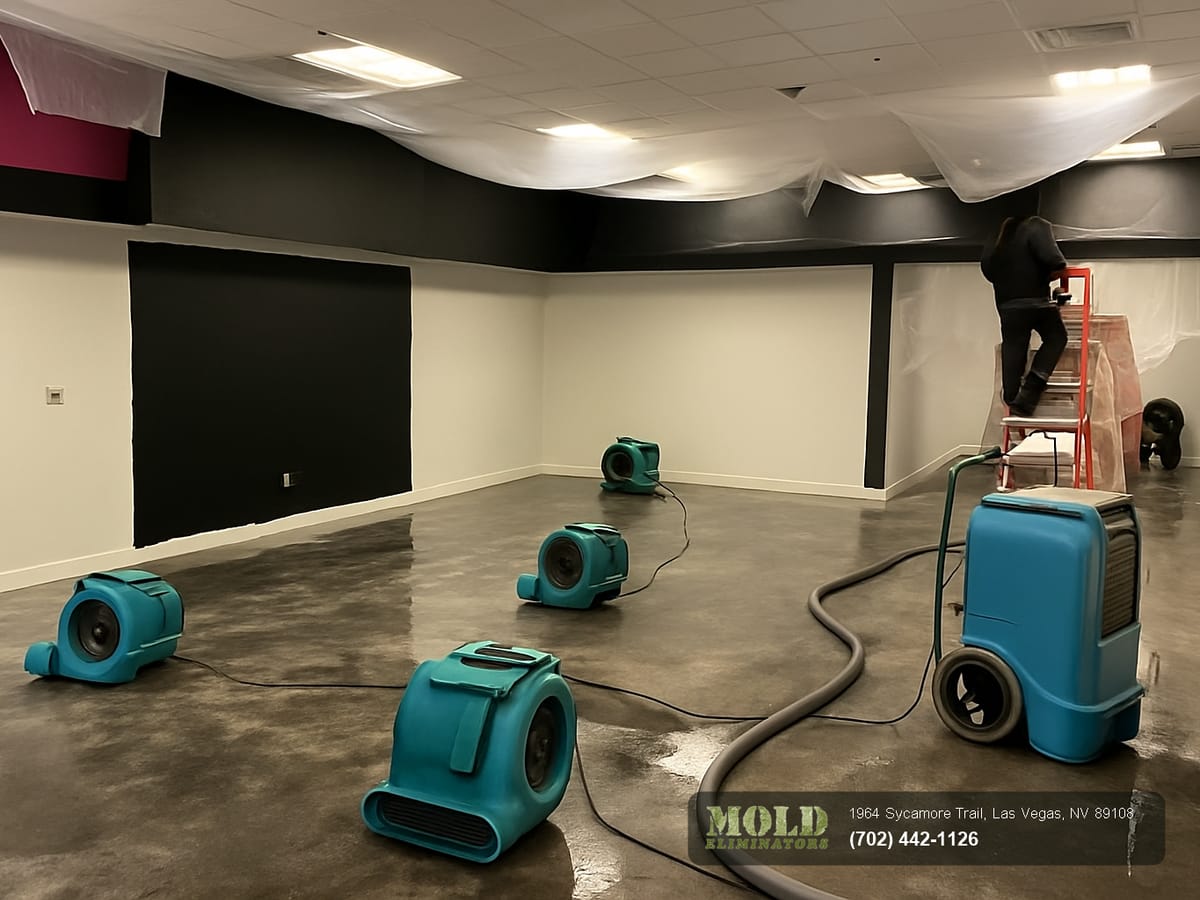
Saving it well takes more than a box fan in the doorway. The structure has to be treated as a closed system of air, materials, and moisture that is balanced on purpose. That means commercial dehumidification to keep the room drier than the wall, air movers placed by design to sweep moisture off the surface, and daily moisture readings logged against a target so you can prove the board actually reached dry. Often a few small “weep” holes are drilled along the bottom plate and the baseboard is pulled so air can reach the wall cavity, which dries the assembly without destroying the visible drywall. Done correctly, the wall is saved, the readings document it, and you avoid a cut-and-replace entirely. This same measured drying discipline is what stops a water problem from quietly becoming a mold problem three weeks later.
When wet drywall has to be cut out
Drying has limits, and an honest crew tells you when you have crossed them instead of selling you a save that will fail. Replacement is the right call when any of these is true:
When drywall does come out, the work behind it matters as much as the patch. The wall cavity, the insulation, and the framing all have to be dried to a verified target and checked for growth before anything is closed back up. Sealing wet framing behind a fresh sheet of drywall is how you trap a mold problem inside a finished wall. If there is any sign that growth already started, the affected area is contained and handled as drywall mold removal with an independent third-party lab confirming the result, rather than a technician simply declaring it clean.
 Cut-out section of drywall revealing a damp wall cavity being inspected for mold
The mold risk hiding behind a wet wall
The reason drywall decisions are taken so seriously is that the failure mode is almost always mold, and it hides. Spores are present in every building, harmlessly, all the time. They bloom into a colony only when they find a wet, organic surface to feed on, and the paper face of soaked drywall is an ideal meal.
The cruel part is that the surface dries first. The wall looks normal and everyone relaxes while the cavity behind it stays damp and a colony quietly establishes. By the time a musty smell, a creeping stain, or a soft spot shows up, the growth has often been working for weeks. That is why “it feels dry” is never the standard we accept. The only way to know a wall is safe is to measure the moisture and, where there is any doubt, verify with testing.
Our anti-upsell rule cuts both ways here. If the readings say the drywall is sound and dry, we tell you so and we do not cut out a wall to pad an invoice. If they say there is growth in the cavity, we show you the numbers rather than asking you to take our word for it.
How we make the repair-or-replace call on site
The decision is not a guess made from the doorway. It follows a deliberate sequence, from the first reading to a documented result, so you can see exactly why a sheet is saved or removed.
- Identify the water category. We confirm the source and whether the water is clean, gray, or black, because contamination overrides almost every other factor in the decision.
- Map the moisture. Pin and pinless meters and thermal imaging map how far the water traveled and how saturated each section of drywall is, giving every area a real number and a baseline.
- Check the timeline. We establish how long the drywall has been wet, because the 24–72 hour window is what separates a dry-in-place candidate from a tear-out.
- Decide dry vs. remove, section by section. Sound, clean, shallow-wet drywall is set up for controlled drying. Contaminated, long-wet, structurally failing, or mold-affected drywall is marked for removal to a clean line.
- Dry the assembly to a verified target. Whether the sheet stays or goes, the cavity, insulation, and framing are dried to a documented standard, with daily readings logged toward that target.
- Verify before closing up. Nothing gets sealed behind new drywall until the readings confirm dry and, where warranted, lab analysis confirms there is no growth. Then the wall is rebuilt.
That documentation is also what an insurance adjuster wants to see, since a sudden, accidental water event like a burst pipe is frequently covered. A moisture map showing the structure going from wet to verified-dry is far stronger than a verbal “we dried it.” This measured approach is the rulebook our owner helped write: Craig Herrmann co-authored the ANSI/IICRC S520 standard and brings that same discipline to every drywall call. You can read more about his credentials and the S520 standard if you want to know who is making the decision on your wall.
What the desert climate changes
It is tempting to assume Las Vegas air is so dry that wet drywall will simply air out on its own. That assumption costs people their walls. Our extreme summer heat can drive moisture deeper into cooler wall cavities through condensation, and the dramatic day-night temperature swings make “it’ll dry itself” an unreliable bet. A swamp cooler leak, a slab leak under a concrete floor, or monsoon intrusion through a roof or window can all soak drywall from directions you would not expect, and slab-on-grade construction holds water far longer than people think.
None of that is visible from across the room, which is exactly why the call gets made on instrument readings rather than appearance. The dry desert surface can lull you into thinking a wall recovered when the cavity behind it is still feeding a problem. If you are unsure whether a past leak left moisture behind your walls, the calm, factual way to find out is a free inspection where we measure first and tell you exactly where you stand before any work is proposed.
Why Las Vegas trusts Mold Eliminators with the call
Decided by the standard
The repair-or-replace call is made against the national standard our owner helped author, not a sales target. Your wall is judged by documented moisture readings and the rulebook, not by “feels dry.” Read more about Craig’s credentials.
Measured, then proven
Meters and thermal imaging define a real dry target, daily readings prove we hit it, and an independent third-party lab confirms there is no growth before a wall is closed. The decision rides on data you can see.
Anti-upsell, in-house
No subcontractors: every technician is a certified W-2 employee, with one-hour emergency response, 24/7. If your drywall does not need to come out, we tell you when you do not need us.
Serving homeowners, property managers, and high-rise condo boards since 1996, across more than 255 properties, we have made this exact call thousands of times. The difference is simple: we map the moisture, decide section by section, dry to a verified target, and document the result, the same way our full water damage restoration work is held to the rulebook from the first reading to the last.
Wet drywall, repair or replace: common questions
- Can wet drywall be saved, or does it always have to be replaced?
- It can often be saved when the water was clean, it was caught within roughly 24–72 hours, the saturation is shallow, and there is no mold yet. In that case controlled drying with dehumidification and daily moisture readings can bring the board back to a verified dry standard. If the water was contaminated, sat too long, soaked too high, or the drywall is structurally failing, replacement is the safer and more honest call.
- How long can drywall stay wet before it has to come out?
- Mold can begin colonizing wet, paper-faced drywall within about 24–48 hours, and after roughly 72 hours the decision usually shifts from “dry and save” to “remove and remediate.” The faster a controlled drying environment is set up, the more drywall you keep, which is why a fast first call matters so much.
- Why do contractors cut drywall a foot or two up the wall?
- That is the “flood cut.” Drywall is removed to a clean line above the highest moisture reading so the wall cavity, insulation, and framing behind it can be dried and inspected. Removing it high enough means nothing wet or contaminated gets sealed back inside the wall, which is how hidden drywall mold takes hold.
- How do you know if the drywall is actually dry inside?
- We measure it. Pin and pinless moisture meters give the board a real moisture content number, and we compare it against unaffected reference areas to set a dry target. The drywall is only declared dry when daily readings confirm it has hit that target, and it is all logged so you and your insurer see the wall going from wet to verified-dry on the record.
- Will my insurance cover replacing water-damaged drywall?
- Often, yes, when the water came from a sudden, accidental event like a burst pipe or a failed water heater, drywall repair or replacement is frequently covered as part of water damage restoration. The documented moisture map is exactly what an adjuster wants, and we log readings, photos, and scope from the first visit and work directly with your carrier.
- What if there is already mold behind the wet drywall?
- Then it becomes a contained removal job, handled as drywall mold removal rather than simple drying, and if the water was contaminated it may also involve flood restoration. An independent third-party lab confirms the area is clean before anything is rebuilt. A free inspection tells us exactly where you stand before any work begins.
Not sure whether to repair or replace your wet drywall?
Get a free, no-pressure on-site inspection. We measure the moisture, check the water category and timeline, and tell you honestly which walls can be saved and which need to come out. One-hour emergency response, 24/7, across the Las Vegas valley.