What to Do After Water Damage: First Steps
First-hour guide
A burst pipe, a failed water heater, or a monsoon that pushed water under the door: the first hour after water damage decides how much you lose and how much you spend. The goal in those first sixty minutes is simple. Stay safe, stop the water, protect what matters, and document everything before you touch it. This guide walks you through exactly what to do, in order, and the few things you should never do.
Most homeowners in Las Vegas meet water damage at a panic moment: standing water on a tile floor at 11 p.m., a ceiling stain spreading by the minute, or a swamp cooler line that let go on the roof. You do not need to fix it perfectly. You need to make a small number of correct moves, fast, and then hand the rest to people who do this every day. The faster the water is removed and the structure is dried, the lower your odds of mold, warped flooring, and a much larger bill. Speed is not about panic. It is about order.
Craig Herrmann has walked into 255-plus Las Vegas properties since 1996, and the homes that recover cleanest are almost always the ones where the owner did three things early: shut off the water, killed power to wet areas when needed, and photographed everything before moving a single box. Everything below builds on those three moves. When the situation is past what you can handle alone, professional water damage restoration picks up exactly where this checklist ends.
The first hour, step by step
Work through these in order. If a step does not apply to your situation, move to the next one. Your safety always comes before your property.
- Make sure it is safe to be in the room. If the water is deep, if it touches outlets or appliances, or if the ceiling is sagging and bulging, stay out and call for help first. No box of belongings is worth an electric shock or a collapse.
- Shut off the water at the source. For a fixture leak, close the local supply valve. For a burst pipe or an unknown source, close the main shutoff (usually near the front of the house, the garage, or an exterior box at the property line). Stopping the flow is the single highest-value move you can make.
- Kill power to the affected area if water is near electrical. If you can reach the breaker panel safely and without standing in water, switch off circuits feeding the wet rooms. If you cannot reach it without crossing standing water, do not wade in. Wait for the utility or a professional.
- Document everything for your insurance claim. Before you move or remove anything, take wide photos of each room and close-ups of the damage, the water line on the wall, and any ruined items. Shoot a slow video narrating what happened and when. This evidence is what supports a clean water damage insurance claim, and it is far easier to capture now than to reconstruct later.
- Move valuables and lift furniture out of the water. Carry out electronics, documents, photos, and anything that will stain or warp. Slide aluminum foil or wood blocks under furniture legs so they stop wicking water and bleeding finish onto wet carpet. Get rugs up off the floor.
- Start removing standing water if it is safe. Mop, towel, or wet-vac what you can reach. Open windows and run fans for airflow, but understand that surface drying is not the same as drying the structure underneath.
- Call a professional. Once you have stopped the source and documented the scene, get a certified crew on the way. A burst pipe at midnight is exactly when emergency 24/7 response matters, and a one-hour arrival window keeps a contained problem from becoming a whole-house problem.
Need help now?
Talk to a Las Vegas expert
In-house certified crews. One-hour emergency response across the valley, 24/7.
What NOT to do after water damage
The wrong moves cause as much damage as the water itself. Skip these:
- Do not use a household vacuum or power strip in standing water. Wet electrical is the most common way a manageable flood turns into an injury.
- Do not assume drywall and carpet that feel dry on the surface are actually dry. Water hides inside wall cavities, under flooring, and in the subfloor, where a meter reads what a hand never will.
- Do not wait to “see if it dries on its own.” In a desert climate the surface fools you while moisture sits trapped below, and that is precisely where mold begins.
- Do not throw out damaged items before they are photographed. Tossing the ruined sofa before the claim adjuster sees it can cost you the reimbursement.
- Do not run the air conditioning or swamp cooler to “circulate” without guidance. Moving contaminated, damp air can spread spores into clean parts of the home.
- Do not tear out walls yourself. Older Las Vegas homes can hide asbestos in drywall and joint compound, and demolition without testing turns a water problem into an air-quality problem.
Why speed matters: the mold clock
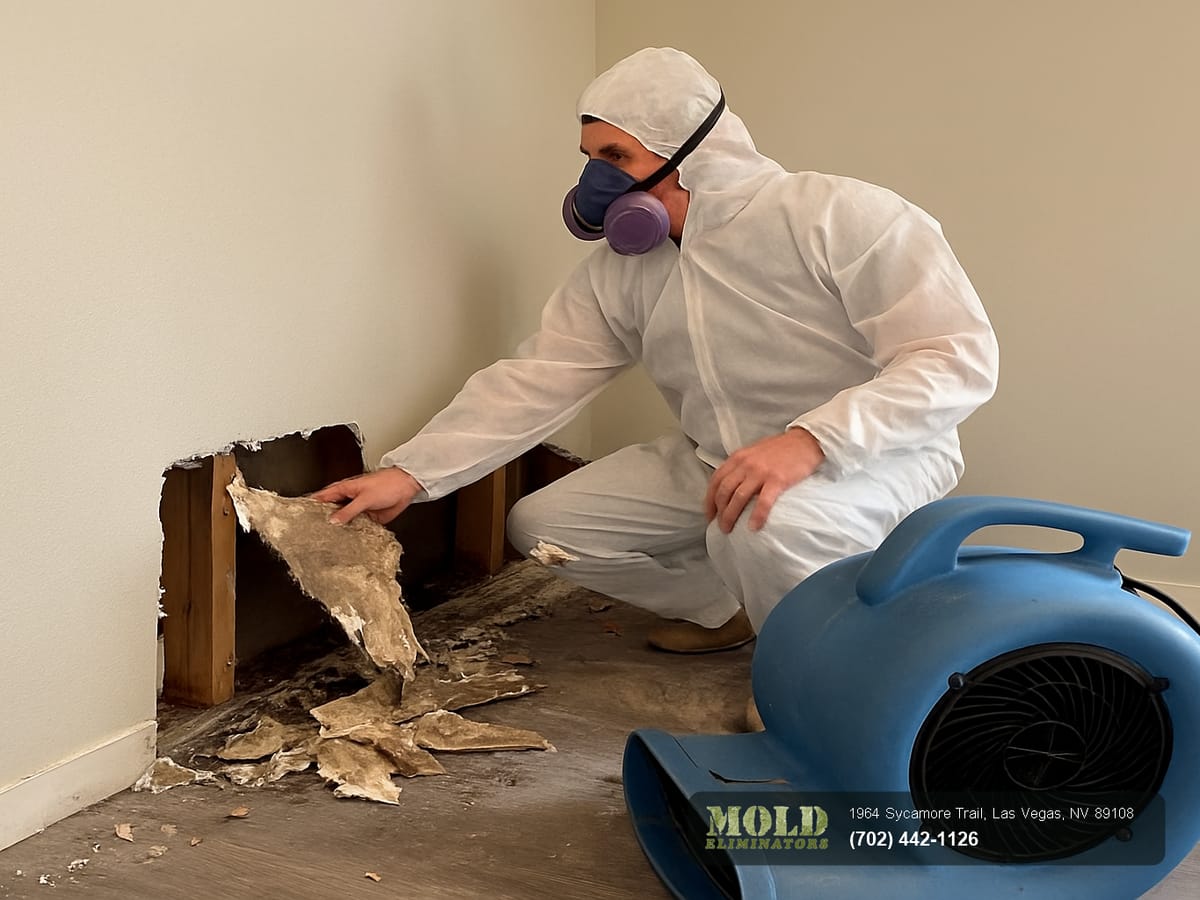
Here is the part most homeowners underestimate. Mold does not wait for the weekend. Under the right conditions, mold can begin growing on wet building materials within 24 to 72 hours. That window is the entire reason restoration crews push to remove water and start drying the same day, not the next morning.
The mechanism is straightforward: standing water and saturated drywall, carpet pad, and framing give mold spores food and moisture at the same time. Once growth starts inside a wall cavity, the fix is no longer “dry the room.” It becomes containment, removal of contaminated material, and verification, which is a different and more expensive job. Getting the structure dry inside that 24-to-72-hour window is the cheapest insurance you can buy against ever needing mold remediation later.
Surface drying with fans is not the same as drying the structure. Proper structural drying uses moisture meters, air movers, and dehumidifiers to pull water out of materials you cannot see, then confirms with readings that the building is actually dry, not just dry to the touch. This is the difference between a problem that ends and one that quietly comes back.
This standards-based approach is not an opinion. Craig Herrmann is a co-author of the ANSI/IICRC S520 standard, the national rulebook for this work, so every job is measured against the document he helped write. You can read more about Craig’s credentials and why the standard matters for your home.
When to call emergency service
Active or large-volume water
A pipe you cannot shut off, a water heater that is still draining, or water spreading across more than one room. The flow needs to stop before anything else can be saved.
Water touching electrical or gas
Standing water near outlets, the panel, or appliances. Do not enter to investigate. A certified crew brings the equipment to handle it safely.
Sewage, slab leaks, or upstairs flooding
Contaminated water, a slab leak under the foundation, or water coming through a ceiling from the floor above all need professional containment and drying right away.
If any of these describe your situation, do not wait until morning. The first hour decides the size of the recovery, and a calm, certified response keeps a contained leak from becoming a full remodel. Mold Eliminators uses in-house, W-2 certified technicians, never subcontractors, and arrives with a one-hour emergency response window across Las Vegas, North Las Vegas, Henderson, Summerlin, Spring Valley, and Paradise.
Common questions after water damage
- How fast can mold start after water damage?
- Mold can begin growing on wet materials in about 24 to 72 hours under the right conditions. That short window is why same-day water removal and verified drying matter so much, and why structural drying is the step that actually prevents regrowth.
- Should I file an insurance claim before or after cleanup starts?
- Document everything with photos and video first, then start emergency mitigation. Insurers expect you to limit further damage promptly, so stopping the water and beginning drying does not hurt your claim. Keeping that evidence supports a smoother water damage insurance claim.
- Do I really need a professional, or can I dry it myself?
- For a small spill you caught immediately, towels and fans may be enough. For standing water, soaked drywall, or any water inside walls and flooring, a professional with moisture meters is the only way to know the structure is truly dry. When in doubt, a free inspection tells you where you stand at no cost.
- What if mold is already showing?
- If you already see growth or smell a persistent musty odor, the job has moved beyond drying. Start with a free mold inspection to confirm what you are dealing with, verified by an independent lab with no incentive to oversell, then plan remediation from facts rather than fear.
Standing in water right now?
Stop the source, photograph the damage, and get a certified crew on the way. We answer 24/7, arrive within the hour, and start with a free inspection so you know exactly what you are dealing with before any work begins.