Water Under Hardwood in Las Vegas
If you are seeing water under hardwood, or watching boards darken, cup, and lift at the seams, your floor is telling you something the surface cannot: moisture has gotten underneath it and it has nowhere to go. Hardwood is a sponge with a varnished lid. Water wicks in fast and leaves slowly, and the longer it sits trapped between the planks and the subfloor, the more it does to your home and the more it invites mold to move in.
The good news is that catching it now, while you can still see water, is the best moment you will get. The boards may still be savable, the subfloor may still be sound, and the source may still be fixable before it does worse. What you do in the next day or two matters far more than what the floor looks like today. This page walks you through what water under hardwood usually means in a Las Vegas home, how urgent it is, and what a proper fix actually involves.
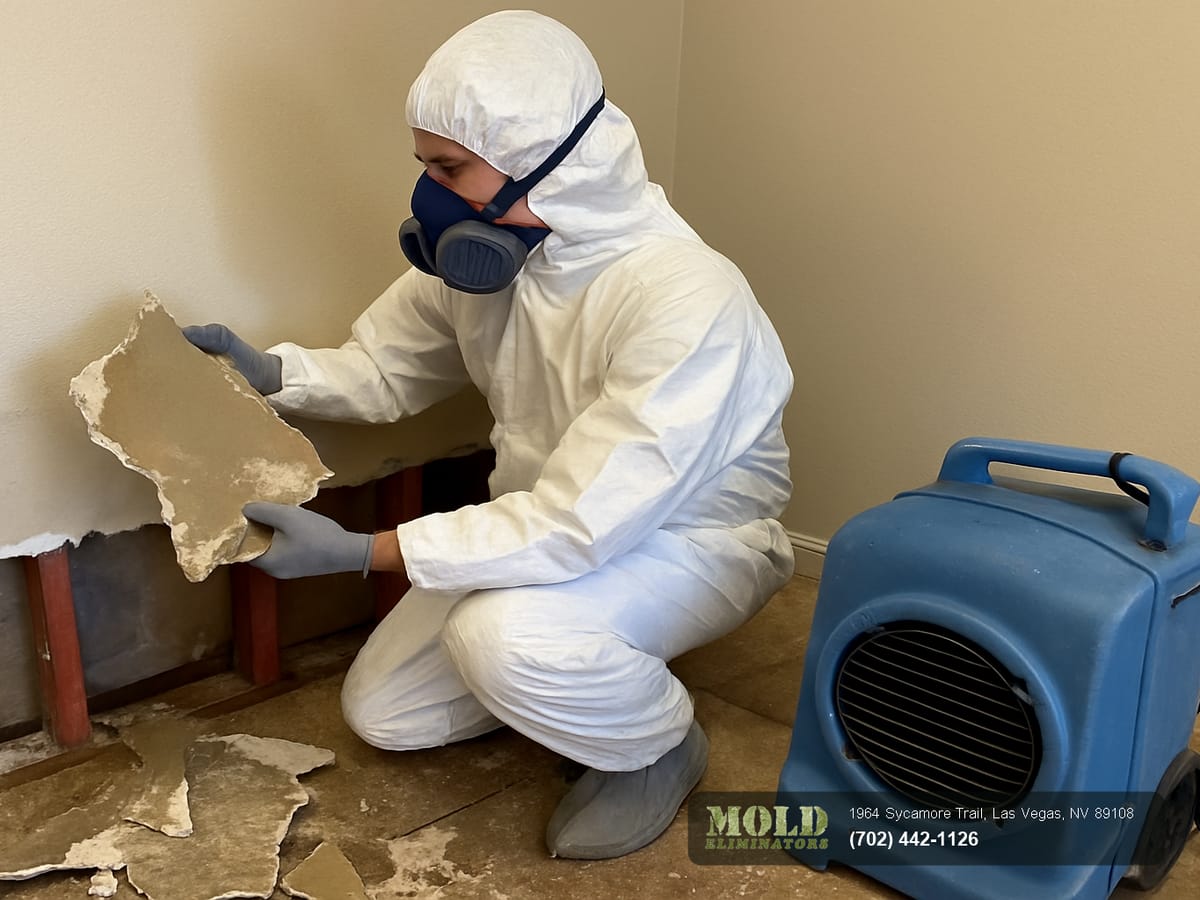 Cupping and water staining spreading across a hardwood floor in a Las Vegas home
What water under hardwood usually means in a Las Vegas home
Hardwood does not hold standing water on top for long. So when you can see water pooling at the seams, beading on the finish, or seeping out as you press a board, the real story is almost always underneath: the subfloor is wet and the moisture is pushing back up through the planks. The question that actually matters is where that water is coming from, because the source decides how urgent the problem is and how big the fix needs to be. In a desert home, a handful of culprits come up again and again.
A slow plumbing or appliance leak. A supply line behind the dishwasher, a refrigerator ice-maker line, a failing water heater, or a pipe in the wall or slab can weep for weeks before the floor finally shows it. By the time hardwood cups, the subfloor below has usually been wet for a while.
A slab leak. Slab-on-grade construction is the norm across the Las Vegas valley, and a pressurized line running through or under that concrete can crack and leak silently. Water finds its way up through the slab and into the flooring, often with no visible puddle and no obvious source, just hardwood that keeps getting wetter.
AC condensation and condensate lines. In our summers the air handler and condensate drain run hard for months. A clogged condensate line or a sweating duct in a closet or hallway can drip steadily onto subfloor and travel under adjacent hardwood, and it tends to peak in the exact heat when you least suspect a water problem.
Swamp cooler overflow. Evaporative coolers are everywhere here, and a stuck float, an overflowing pan, or a leaking water line can send a slow trickle down a wall and across a floor, soaking the subfloor under hardwood near the unit or below an attic-mounted cooler.
Monsoon intrusion. Las Vegas gets very little rain, but when summer monsoon storms hit, they hit hard and fast. Water can push under a door threshold, through a window, or down from a roof penetration and run under flooring before it ever shows as a stain on the wall.
Honest diagnosis matters because the fix is different for each. A capped appliance leak that gets dried in time may cost you nothing but a few boards. A slab leak ignored for a month can mean a buckled floor, a saturated subfloor, and a mold colony underneath. The only way to know which one you have is to find the source first, which is exactly where a proper response starts.
Need help now?
Talk to a Las Vegas expert
In-house certified crews. One-hour emergency response across the valley, 24/7.
Why it matters and how urgent it really is
Water under hardwood is genuinely time-sensitive, and the clock is shorter than most homeowners expect. Mold can begin to colonize wet organic material, and almost everything under your floor qualifies, from the wood planks to the plywood subfloor to the paper facing on nearby drywall, within roughly 24 to 48 hours of getting wet. After about 72 hours the conversation shifts from drying and saving the floor to removing and replacing it. That window is the whole reason this is treated as an emergency rather than a someday repair.
There is structural damage on the table too. Trapped moisture cups and crowns hardwood, swells the subfloor, pops nails and fasteners, and can rot framing if it reaches that far. A floor that might have been dried and saved in the first two days can become a full tear-out by the end of the week. And because hardwood seals moisture in beneath a finished surface, the wood often dries on top and stays soaked underneath, hiding the real problem while it keeps feeding mold.
Las Vegas adds its own twist. Our dry desert air fools people into assuming a floor will simply air out, but a sealed wall cavity or a concrete slab can hold water for weeks regardless of how dry the room feels. Our extreme summer heat can drive moisture deeper into cool subfloor and slab through condensation rather than pulling it out. If you smell a musty, damp edge near the floor, or a room that just stays muggy, that odor is usually microbial growth already getting started in a space you cannot see. The faster the water is found and the structure is dried, the more of your floor you keep and the lower the mold risk drops.
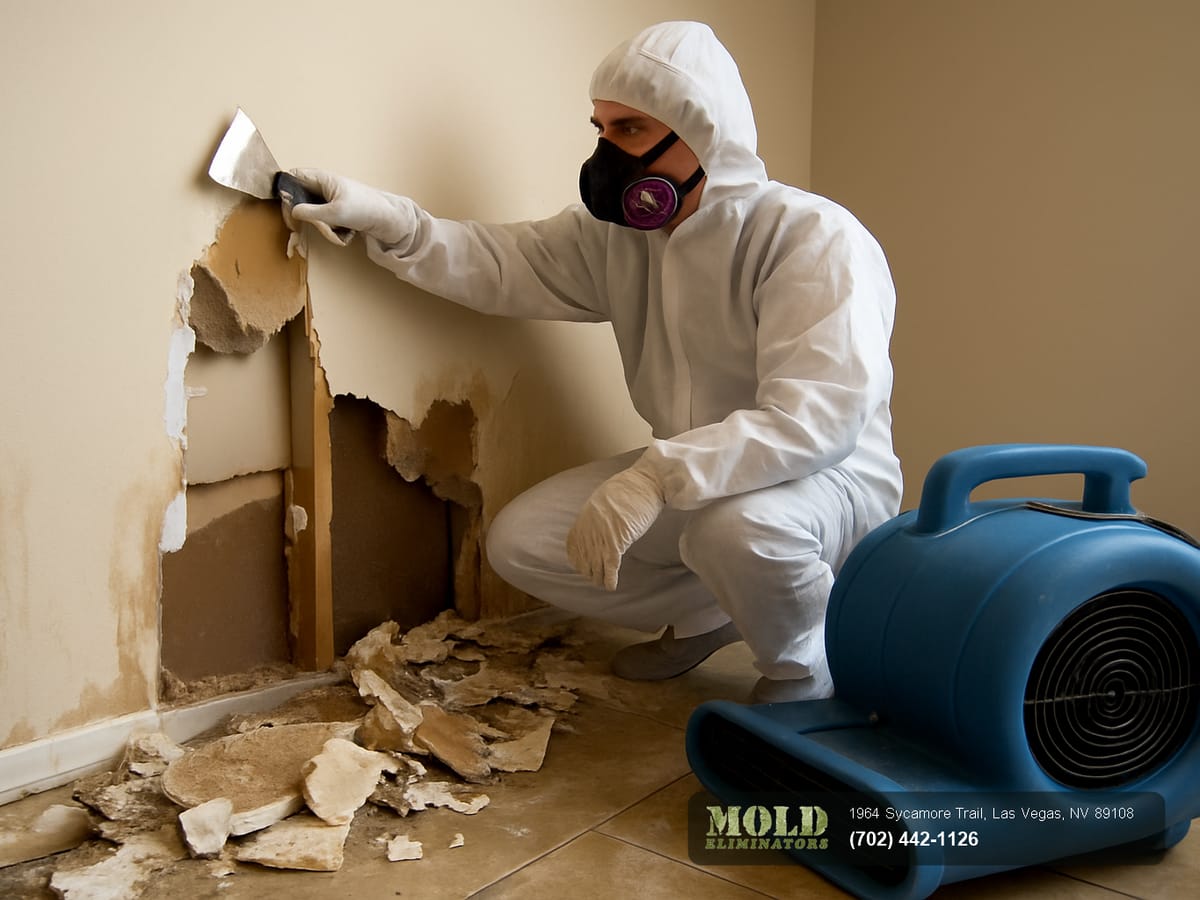 Technician using a moisture meter to map water trapped under hardwood flooring
What the proper fix involves, to the S520 standard
A correct response is not “rip up the floor and see.” It is a measured sequence that finds the water, controls it, and proves the result. Mold Eliminators runs it to the ANSI/IICRC S520 standard, the national mold remediation rulebook that our founder Craig Herrmann co-authored, so the work is held to the rulebook rather than to a guess.
- Free on-site inspection first. We come out and look before anyone quotes a tear-out. The on-site inspection is free, and it is where we find the source of the water and map how far it has traveled under the floor.
- Find and stop the source. Drying a floor while a slab leak or condensate line keeps running is pointless. We trace the water to its origin, whether that is plumbing, AC, a swamp cooler, or intrusion, so the fix lasts.
- Contain the area. If mold is present or likely, we contain the work zone so spores and moisture do not spread into clean parts of the home while we work.
- Remove what cannot be saved. Boards and subfloor that are too far gone come out. Hardwood caught early can often be dried in place, and we tell you honestly which situation you are in.
- Dry to verified targets. Commercial dehumidifiers and air movers, placed by design, pull moisture out of the subfloor and structure. Daily meter readings drive the schedule, and the equipment comes out only when every material hits its documented dry target.
- Independent lab clearance. When mold is involved, an independent third-party lab verifies the result rather than us declaring it clean. You get data, not a technician’s say-so.
This is the same discipline behind full hardwood floor water damage work and broader water damage restoration: measure first, dry to the data, then prove it. Skip the measuring and you are simply hoping the floor is dry, and hoping is how a water problem quietly becomes a mold problem three weeks later.
Why Las Vegas homeowners call us for this
No subcontractors
Every technician is a certified W-2 employee of Mold Eliminators. One in-house crew owns the water, the drying, and the mold risk from the first reading to the verified-dry result. No handoffs, no finger-pointing.
Independent lab, anti-upsell
Clearance comes from an independent third-party lab, not from us. And we tell you when you do not need us. If your floor can be dried and saved, we will not sell you a tear-out you do not need.
One-hour response, 24/7
Water under hardwood is on a clock, so we are too. We answer 24/7 with a one-hour emergency response across the valley, because the faster drying starts, the more of your floor survives.
Craig Herrmann has been doing this in the Las Vegas valley since 1996, is IICRC Master Certified, and has worked on 255+ properties. When water is actively spreading right now, the right move is our 24/7 emergency line, where we stabilize the water first and start drying immediately. If it is not an emergency but you want answers, a free inspection is the calm, factual way to find out exactly what is under your floor.
Water under hardwood in Las Vegas, common questions
- Can my hardwood floor be saved, or will it all have to come out?
- It depends entirely on how long the water has been there and how deep it went. Hardwood caught early, while you can still see water, can often be dried in place and saved. Once boards have cupped hard, buckled, or sat wet for more than a few days, some or all may need to come out. We map the moisture and tell you honestly which situation you are in before any board is pulled, as part of hardwood floor water damage work.
- There is no puddle and I cannot find the source. What now?
- That is common in Las Vegas, where slab leaks and condensate-line drips often soak a floor with no visible source. Slab-on-grade construction lets water travel up through concrete silently, and a clogged AC condensate line can drip behind a wall. Finding the source is the first thing we do on a free on-site inspection, using moisture meters and thermal imaging to trace the water back to where it starts.
- Is mold testing free too?
- The on-site inspection is free. If lab testing or analysis is needed to confirm mold or to clear the area, that is a paid add-on handled by an independent third-party lab, so the result is verified data rather than our word. We will tell you up front whether testing is warranted, and we never push it when it is not. Start with a free inspection and we will explain exactly where you stand before anything is charged.
Water under your hardwood? Find the source and dry it right, starting with a free inspection.
A free, no-pressure on-site inspection finds the water you cannot see and tells you whether your floor can be saved. One-hour emergency response, 24/7, across the Las Vegas valley. We dry to verified targets and prove the result, so the problem ends here, not in three weeks.