Appliance Leak Water Damage in Las Vegas
Water Damage Knowledge
An appliance leak rarely announces itself. By the time you see the water, it has often been wicking into your subfloor, cabinet bases, and drywall for days. This guide walks Las Vegas homeowners through how water heaters, washing machines, dishwashers, and refrigerator ice-maker lines fail, what the damage looks like under cabinets and flooring, and how proper drying prevents mold from following the water.
Appliance leaks are one of the most common forms of water damage restoration we respond to across the valley. They are also the most underestimated. A roof leak or a slab leak feels like an emergency the moment it happens. An appliance leak is sneaky: a slow drip behind the dishwasher, a sweating supply line under the sink, a water heater that lets go a cup an hour for a week before it finally bursts. The volume is small at first, so the homeowner does not react, and the water keeps finding the lowest, most hidden path it can.
The result is damage that is already structural by the time it is visible. Water that has been sitting under a cabinet toe-kick or migrating along a flooring seam has had time to soak into porous building materials, and in Las Vegas that means the conditions for mold growth are quietly being set up inside walls and cabinet boxes. Understanding how each appliance fails, and acting on the early signs, is the difference between a dry-out and a demolition.
How household appliances cause water damage
Every water-using appliance in your home is connected to a supply line, a drain, or both, and every one of those connections is a potential failure point. The failures fall into two broad categories: slow hidden leaks that develop over weeks, and sudden bursts that dump tens of gallons in minutes. Both are damaging. The slow leak does more hidden harm because nobody intervenes; the sudden burst does more visible harm because the volume is overwhelming.
What follows is how the four most common culprits in Las Vegas homes actually fail, and what the early warning signs look like before the floor is underwater.
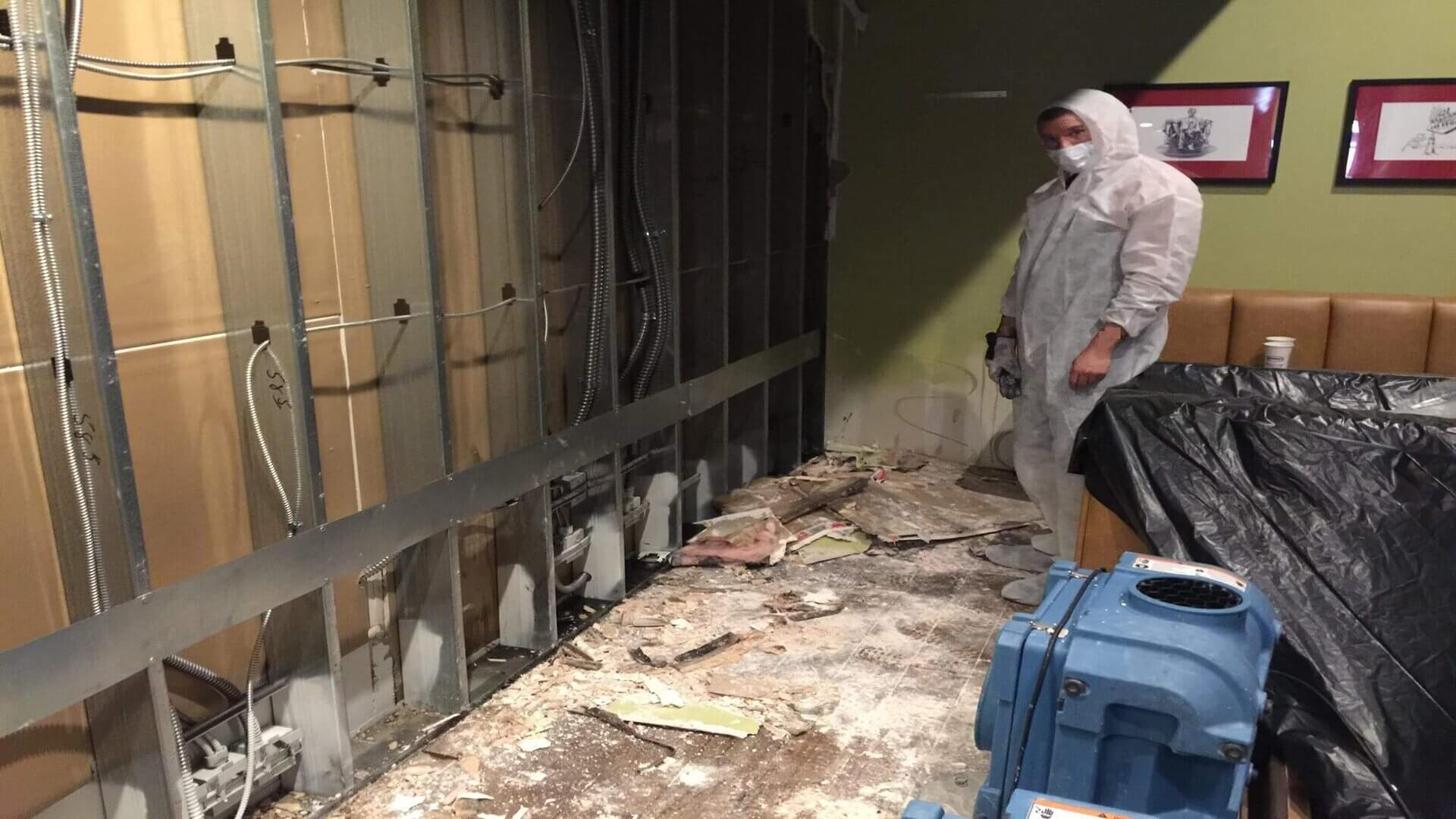 Appliance leaks often hide under cabinets and flooring before they surface.
Water heater failures
A water heater is a 40 to 50 gallon tank under constant pressure, and it is the appliance most likely to cause a catastrophic sudden burst. Tanks corrode from the inside out, so the failure is invisible until the shell finally splits and the entire contents flood the floor, often in a garage or a hall closet where it can run for hours before anyone notices. Hard water accelerates this: Las Vegas sits on some of the hardest municipal water in the country, and the constant mineral scaling shortens tank life and stresses the relief valve.
The warning signs are subtle. Rusty water, a slow weep at the base of the tank, popping or rumbling sounds from sediment, or a relief valve that drips are all telling you the unit is near the end. A water heater on a second floor or above finished living space is the worst case, because the burst sends water straight down through the ceiling. When that happens, you need an emergency response fast, because the clock on mold starts immediately.
Washing machine leaks
Washing machines fail at the rubber supply hoses far more often than at the machine itself. Those braided or rubber hoses are under household water pressure 24 hours a day, whether the machine is running or not, and when one ruptures it can release several hundred gallons an hour. Because laundry rooms are frequently interior or on upper floors, the water spreads into adjoining rooms and down through floors before it is discovered.
Slow washing machine leaks are common too: a cracked drain hose, a worn door gasket on a front-loader, or an overflowing drain standpipe that lets a little water escape every cycle. That repeating small spill keeps the wall cavity behind the machine perpetually damp, which is exactly the environment where hidden mold takes hold. If you smell must in a laundry room or see staining at the base of the wall, the leak has been active for a while.
Dishwasher and supply-line leaks
Dishwashers leak from the door seal, the supply line, the drain hose, or the pump, and almost all of that water goes where you cannot see it: down beneath the unit and out under the adjacent base cabinets. A dishwasher leak is one of the most destructive precisely because it is so well hidden. The water runs along the subfloor under the cabinet run, soaking particleboard cabinet bases and the flooring underlayment, often for months before a warped floorboard or a soft spot finally gives it away.
The classic Las Vegas dishwasher failure starts at a supply-line connection that was never quite tight, drips a teaspoon a day, and slowly destroys the cabinet to its left. By the time you notice, the cabinet box is delaminating and there is dark growth on the back wall.
Refrigerator and ice-maker line failures
The single most under-recognized appliance leak in the home is the ice-maker supply line. It is a thin plastic or copper tube running to the back of the refrigerator, frequently a cheap push-fit fitting, and it sits hidden behind a heavy appliance that nobody moves. When that fitting fails or the line cracks, it leaks directly onto the floor behind and under the fridge, the one spot in the kitchen no one ever looks. We have seen ice-maker lines drip for a year, rotting the subfloor and the bottom plate of the wall before anyone noticed the floor near the fridge felt spongy.
Defrost drain clogs and door-gasket condensation add slow moisture too, but the supply line is the one that causes real structural damage. If your refrigerator has an ice maker or water dispenser, that line is worth checking twice a year.
Need help now?
Talk to a Las Vegas expert
In-house certified crews. One-hour emergency response across the valley, 24/7.
Slow hidden leaks versus sudden bursts
The way an appliance fails shapes how you should respond. A sudden burst is loud and obvious: gallons on the floor, an audible rush, water spreading fast. It is alarming, but it is honest. You know exactly when it started and you can shut off the water and call for help while the damage is still fresh and largely on the surface.
A slow hidden leak is the more dangerous of the two precisely because it gives you nothing to react to. A few ounces a day evaporates off the visible floor while the rest wicks into porous materials below. Over weeks, that water saturates the subfloor, the cabinet bases, the drywall bottom plate, and the wall cavity. There is no puddle to alarm you, just a slowly worsening musty smell and, eventually, a soft spot or a stain. By then the moisture has been feeding hidden growth for a long time.
Damage under cabinets and flooring
Appliance water is almost always cabinet-and-floor water. It enters at a kitchen or laundry connection and immediately follows gravity into the spaces below, where the materials are the most vulnerable in the house. Cabinet boxes are typically particleboard or MDF, which swells and crumbles once wet and never recovers. Flooring underlayment and subfloor soak and hold moisture against the finished floor above. The wall bottom plate and the lowest few inches of drywall wick water upward.
Because all of this is enclosed, it dries extremely slowly on its own, if it dries at all. Trapped moisture under a vinyl or laminate floor has nowhere to evaporate, so it sits and sustains growth. This is why surface drying with a household fan is never enough for an appliance leak. The water you cannot see is the water that matters, and removing it requires structural drying with calibrated moisture meters, air movers, and dehumidification that pulls water out of the building cavity itself, not just off the surface.
When materials have been wet long enough, growth can establish inside the wall where it is invisible from the room. We routinely find mold behind walls downstream of an old dishwasher or ice-maker leak, which is exactly why proper assessment looks past the drywall surface and measures what the cavity is actually holding.
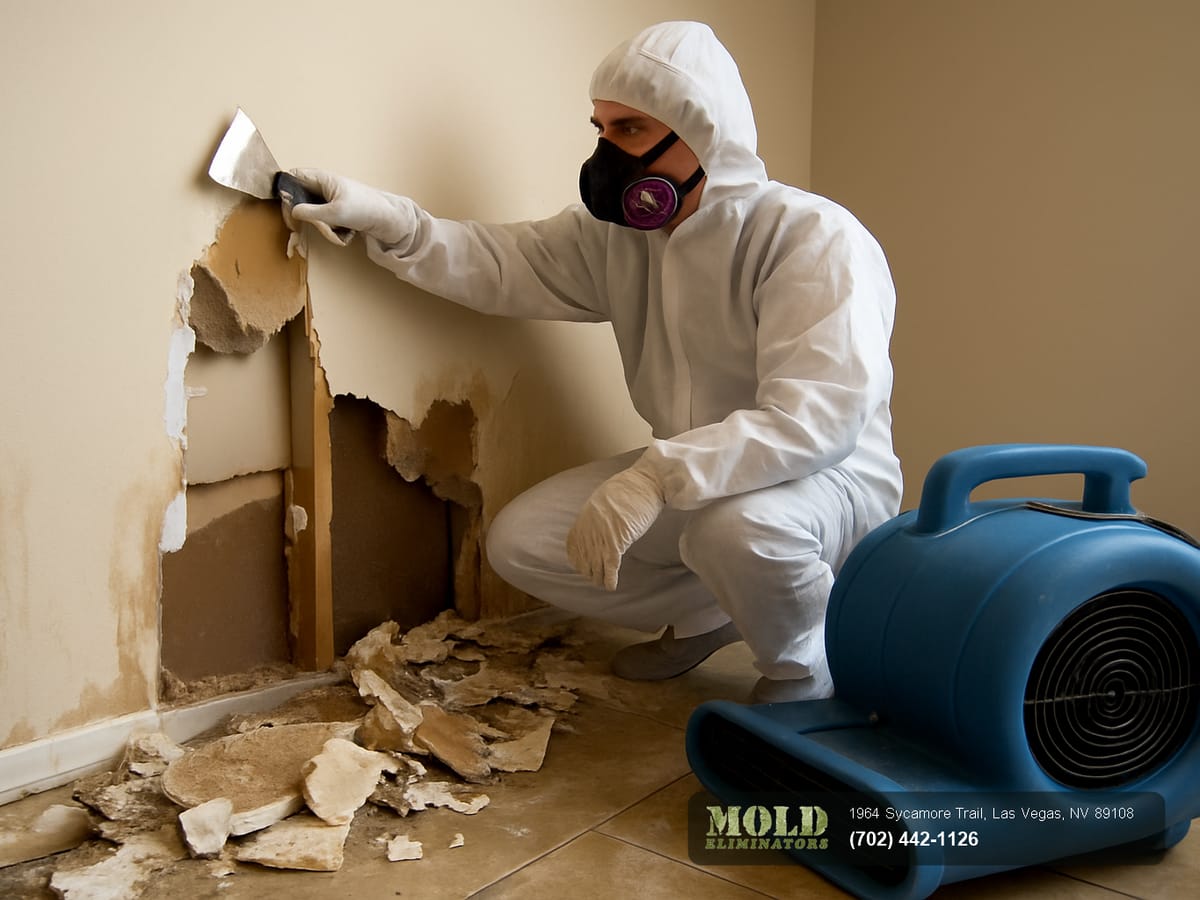 Water damage to base cabinet and subfloor from a slow appliance leak
Hard water makes it worse
Las Vegas water is exceptionally hard, and that mineral load does more than shorten the life of your water heater. Scale builds inside supply lines, valves, and fittings throughout the home, stiffening rubber hoses, fouling shutoff valves, and corroding the very connections that are supposed to hold back pressure. An appliance that might last 12 years elsewhere is stressed harder here. That is part of why valley homes see a steady stream of appliance failures, and why staying ahead of aging hoses and valves matters more in this climate than most homeowners realize.
Drying, mold prevention, and the restoration process
When an appliance leak is caught, the goal is simple to state and demanding to execute: get every affected material back to a normal dry standard before mold can establish. In the desert, ambient air is dry, but a saturated cabinet cavity or subfloor stays wet long enough for growth to start within 24 to 72 hours. The response has to be both fast and measured.
- Stop the source and assess. The leaking line or appliance is isolated, then we map the true extent of the moisture with meters and thermal imaging. The water you can see is never the full picture, so the assessment defines where drying actually has to reach.
- Extract and remove unsalvageable materials. Standing water is extracted, and materials that cannot be dried in place, swollen cabinet bases, saturated underlayment, are removed. Where containment is needed to keep work areas clean, we set it before disturbing anything.
- Dry the structure to standard. Air movers and commercial dehumidifiers pull moisture out of the subfloor, wall cavity, and cabinet boxes, with daily readings confirming progress. Drying is not done when the surface feels dry. It is done when the meters say the materials have reached the dry standard.
- Verify and address any growth. If moisture sat long enough for mold, the affected areas are handled through proper mold remediation with containment and post-work clearance, not painted over. We confirm the result with independent third-party lab testing rather than self-certifying our own work.
- Restore. Once everything is verified dry and clean, finishes, flooring, and cabinetry are rebuilt.
This is the part where the standard matters. The drying targets and clearance criteria we work to come from the ANSI/IICRC S520 mold standard, which our owner Craig Herrmann co-authored. That means the job is judged against the rulebook itself, and verified by a lab with no incentive to find more work. If the cavity is dry and clean, we say so and we are done. We do not invent problems, and if your appliance leak was caught early enough that no remediation is needed, we will tell you that plainly. To confirm whether a leak has led to a mold issue, a free mold inspection settles the question without any obligation.
Appliance leaks and your insurance
Most homeowner policies cover sudden and accidental appliance leaks, the burst water heater or the ruptured washing machine hose, because the damage was abrupt and unforeseen. What they typically exclude is damage from a leak that was gradual, long-term, or the result of deferred maintenance. This is the central tension of appliance leaks: the slow hidden leak that does the most damage is also the one an adjuster is most likely to dispute as a maintenance issue.
Two things protect you. First, act fast. The sooner a leak is documented and dried, the easier it is to show the damage was addressed promptly rather than ignored. Second, get accurate, documented moisture readings and an independent assessment from the start, so the scope of damage is recorded objectively rather than guessed at later. Thorough documentation, real measurements, and independent lab verification give you a defensible record if a claim is questioned. If you are unsure where your situation falls, the fastest path to an answer is to contact us and have it assessed before more water moves.
- How fast does mold grow after an appliance leak?
- Mold can begin to establish within 24 to 72 hours of materials staying wet. Even in dry desert air, an enclosed cabinet or subfloor cavity holds moisture long enough for growth, which is why prompt structural drying is the single best prevention.
- Can a slow dishwasher or ice-maker leak really cause structural damage?
- Yes. A leak of just a few ounces a day, sustained for months under a cabinet or behind a refrigerator, will rot the subfloor and the wall bottom plate and can lead to mold behind walls long before any water is visible in the room.
- Do I need full remediation or just drying?
- It depends entirely on how long materials stayed wet. If a leak is caught early and dried to standard, drying alone may be enough. If moisture sat long enough for growth, proper mold remediation is needed. A free mold inspection tells you which, with no obligation.
- Will my insurance cover an appliance leak?
- Sudden, accidental failures are usually covered; gradual long-term leaks are often excluded as maintenance. Acting quickly and getting documented, independent moisture readings gives you the best record for a claim.
- Do you serve my area of the valley?
- We respond throughout Las Vegas, North Las Vegas, Spring Valley, Paradise, Henderson, and Summerlin. See our service areas for details, and for active leaks our emergency response is available around the clock.
Caught an appliance leak?
Get a free inspection before the water spreads
If a water heater, washer, dishwasher, or fridge line has leaked in your Las Vegas home, the moisture you cannot see is what matters. We will measure the real extent, dry it to the S520 standard, and verify the result with an independent lab. No upsell, no scare tactics.