What is a slab leak and how do I know I have one?
A slab leak is a water leak in one of the pipes running beneath or inside the concrete foundation slab your home sits on. You usually find out you have one indirectly: a spike in your water bill, the sound of running water when every fixture is off, a warm or damp spot on the floor, or an unexplained musty smell are the classic early signs.
Slab leaks are common in Las Vegas because so many homes here are built slab-on-grade, with copper or PEX supply lines cast right into the concrete. Shifting desert soil, hard mineral-heavy water, and decades of pressure wear the pipe until it weeps or bursts. The leak itself is a plumbing problem, but the water it releases under your slab is where it becomes our problem. Trapped moisture under a foundation is exactly the slow, hidden source that feeds mold, which is why catching one early matters far beyond the plumbing repair.
What a slab leak actually is, in plain English
Your house sits on a poured concrete foundation called a slab. In slab-on-grade construction, which is the norm across the Las Vegas valley, the water supply lines and sometimes the drain lines run either through that slab or in the soil directly beneath it. A slab leak is simply a failure in one of those buried lines: a pinhole, a crack, or a full break that lets pressurized water escape into the ground and concrete under your floor.
There are two broad types. A pressure-side leak comes from a supply line carrying clean water under pressure, so it leaks continuously, day and night, whether or not anyone is using water. A drain-side leak comes from a waste line and only releases water when something upstream is draining, so it tends to be sneakier. Pressure-side leaks usually show up on your water bill first, while drain-side leaks often announce themselves with odor or soft, settling soil.
Why do they happen so often here? Three desert-specific reasons stack up. First, our soil expands and contracts with moisture and heat, and that constant ground movement stresses rigid pipe. Second, Las Vegas tap water is famously hard, and years of mineral scale plus abrasion wear thin copper from the inside out. Third, slab homes from the building booms of the 1990s and 2000s are now reaching the age where original plumbing simply fails. None of that is alarming on its own. It is just the normal arithmetic of pipes, water, and time.
Need help now?
Talk to a Las Vegas expert
In-house certified crews. One-hour emergency response across the valley, 24/7.
How do I know if I have one? The real signs to watch
You almost never see a slab leak directly, because the water is trapped under concrete. Instead you read the symptoms it leaves behind. Any one of these on its own can have another explanation, but two or three together is a strong signal worth investigating.
Here is the honest caveat: none of these signs are proof, and plenty of slab leaks give almost no surface clue at all for a long time. The water hides under concrete, so the only way to truly know what moisture is doing under and around your slab is to measure it. A plumber confirms and repairs the leak in the pipe. What we do is the next, separate question: did that hidden water leave a moisture or mold problem behind in your structure?
What to do next if you suspect a slab leak
Take it in order. The plumbing comes first, then the structure. Rushing past either step is how a fixable leak quietly becomes a mold problem.
- Confirm the leak with a plumber. A licensed plumber locates and repairs the failed line under the slab. That stops the water at its source. This is the plumbing half of the job and it has to happen first.
- Stop assuming the area dried on its own. Water trapped under and beside a slab does not air-dry the way a surface spill does. Concrete holds moisture for weeks, and the desert heat above can actually drive that moisture deeper into cool wall cavities through condensation. Looking dry and being dry are not the same thing.
- Get the affected materials properly dried. If the leak soaked subfloor, drywall, baseboards, or insulation, those materials need controlled structural drying to a measured, documented standard, not just a fan and time. This is the step that decides whether the water problem ends or becomes a mold problem.
- Have the moisture and mold risk assessed. Because the water sat hidden, the only way to know your structure is sound is to measure it. We offer a free inspection for homeowners and property owners, an on-site visit where we read moisture levels and look for any growth the leak may have started. If lab analysis is warranted, samples go to an independent third-party lab and are billed at cost. The inspection is free; the lab work is the only paid add-on, and only if it is actually needed.
If the leak was a sudden, larger event rather than a slow weep, the cleanup overlaps with full water damage restoration, and if ground water or a drain line was involved it can edge into flood restoration territory. Whatever the scale, the principle is the same: fix the pipe, dry the structure to a verified standard, and confirm with data that nothing was left behind. We are anti-upsell by design, so if your structure is genuinely dry, we will tell you that and you will owe us nothing.
Why this advice is worth trusting
The reason we treat the moisture under a slab as seriously as the leak itself is that the science of where mold comes from is not a matter of opinion. It is a national standard, and our founder Craig Herrmann co-authored it. Craig is IICRC Master Certified and helped write the ANSI/IICRC S520 standard, the rulebook the entire remediation industry follows. He has worked Las Vegas water and mold problems since 1996, across more than 255 properties.
That matters here because slab leaks are a textbook case of hidden moisture, and S520 is built around exactly that: find the water you cannot see, dry it to a measurable target, and verify rather than assume. We send no subcontractors. Every technician is an in-house, certified W-2 employee, and any lab analysis goes to an independent third-party lab, never an in-house one that has a reason to find a problem. You can read more about Craig Herrmann and his credentials if you want to know who is standing behind the advice.
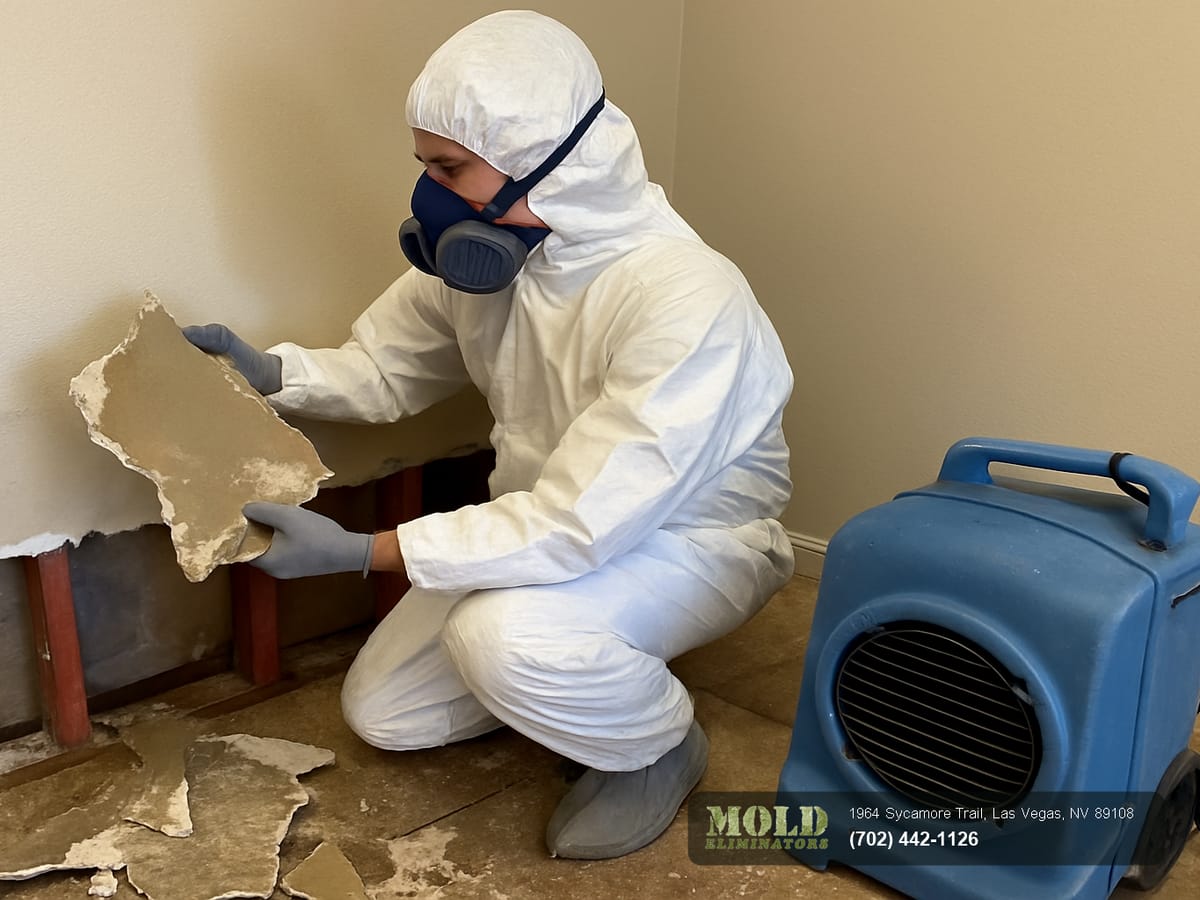 Moisture reading taken near a slab in a Las Vegas home
Related questions
- Can a slab leak cause mold?
- Yes, and it is one of the more common hidden causes we see. Mold spores are present in every building all the time, and they only bloom into a colony when they find a wet surface to feed on. A slab leak supplies exactly that: a slow, constant source of trapped moisture that the surface above never shows. Fixing the pipe stops the water, but if the leak ran for weeks, the materials it soaked may already be feeding growth. That is why the right move after a repair is a moisture check, then proper structural drying if anything is still wet.
- Is mold inspection after a slab leak really free?
- The on-site inspection is free for homeowners and property owners. We come out, measure moisture, and look for any growth the leak may have started, at no cost. What is not free is lab analysis: if a sample needs to be analyzed, it goes to an independent third-party lab and is billed to you at cost, and only when that testing is actually warranted. We will never tell you that lab testing is free, because it is not, and we will not run a lab test you do not need. Schedule the free inspection first and we will tell you honestly whether anything beyond it is justified.
- How long can a slab leak go undetected?
- Often months, sometimes longer, especially a drain-side leak that only releases water intermittently. That is exactly why slab leaks are dangerous for your structure even when the plumbing repair is simple. The longer water sits under the slab, the more likely it has wicked into framing, subfloor, or drywall and started a mold problem out of sight. If a leak was recently repaired but you never had the moisture verified, a free inspection is the calm, factual way to find out whether the water left anything behind, and full water damage restoration is available if it did.
Suspect a slab leak left moisture behind? Start with a free inspection.
We come out, measure the moisture under and around your slab, and tell you honestly where you stand. One-hour emergency response, 24/7, across the Las Vegas valley. The on-site inspection is free; any lab analysis is independent and billed only at cost if it is actually needed.