Water Under Flooring in Las Vegas
If you are seeing water under flooring, lifting a tile to find a wet edge, or watching a dark line creep across the laminate, your home is telling you something important: liquid has gotten into a place it was never meant to reach, and it is already soaking into the materials underneath. Water pooling beneath a floor is almost never a cosmetic issue. It is a signal that there is an active or recent source somewhere, and that the subfloor, the slab, or the framing below is holding moisture you cannot see.
The good news is that catching it now, while you can still see it, is the best possible time to act. The honest truth is that a wet floor that is left to dry on its own rarely dries the way people hope. The surface firms up, the puddle disappears, and the moisture quietly stays trapped in the assembly below, where it feeds the exact conditions mold needs. This page walks you through what water under your flooring usually means in a Las Vegas home, why it matters, and what a proper fix actually involves.
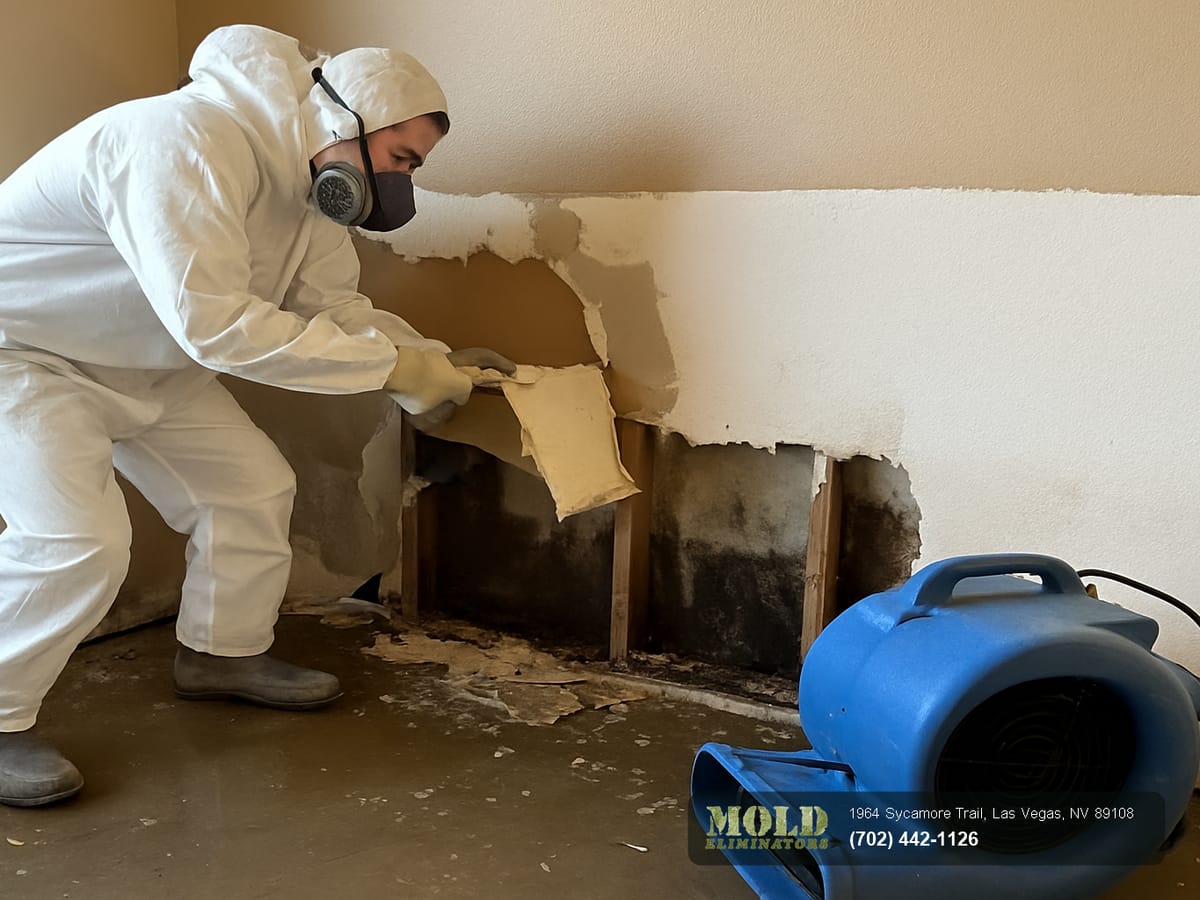 Water seeping under flooring at the baseboard of a Las Vegas home
What water under flooring usually means in a Las Vegas home
Water does not appear under a floor without a reason, and in the desert the likely causes are a little different than they would be elsewhere. The first job is to figure out where it is coming from, because the source decides everything about the fix. Here is what we most often find behind this exact symptom in Las Vegas homes.
A slab leak. Many homes here are built slab-on-grade, with water lines running through or under the concrete. When one of those pressurized lines fails, water travels under the slab and finds its way up through seams, expansion joints, and the edges of flooring. A slab leak can run for weeks before the floor finally shows it, which is why the water often seems to appear from nowhere.
A hidden supply or drain line. A pinhole in a copper line, a loose fitting behind a dishwasher, a failing water heater, or a slow toilet seal can all release water that runs along the subfloor and pools at the lowest point, often a room or two away from the actual leak.
AC condensation and overflow. Las Vegas runs its air conditioning hard for months. A clogged condensate drain or an overflowing drain pan can quietly drip into the floor structure all summer, and the water shows up under flooring near a closet, a hallway, or a wall shared with the air handler.
A swamp cooler line. Evaporative coolers are common here, and their water supply lines and bleed-off lines fail more often than people expect. A leak from a rooftop or attic-mounted cooler can travel down inside a wall and surface under the flooring below.
Monsoon and storm intrusion. Our summer monsoon dumps a lot of rain in a short window onto ground and roofs that are not used to it. Water can push in under a door threshold, through a foundation crack, or down from a roof penetration and spread under the flooring before you ever see a drop on the surface.
Sometimes more than one of these is in play at once. What matters is that the source gets identified and stopped first, because drying a floor while water is still arriving is a waste of time and money. That is the starting point of real water damage restoration, and it is the first thing we do on site.
Need help now?
Talk to a Las Vegas expert
In-house certified crews. One-hour emergency response across the valley, 24/7.
Why this matters and how urgent it is
There is a clock on water under flooring, and it is not generous. Mold can begin to colonize wet organic materials within roughly 24 to 48 hours, and most of what is under your floor is organic: the paper facing on the drywall the water wicked into, the wood subfloor, the framing. After about 72 hours the conversation shifts from saving the materials to removing them. That window is the whole reason a wet floor is treated as urgent rather than a problem for next weekend.
The desert adds its own complications. Slab-on-grade concrete holds water far longer than people expect, so a slab that feels dry on top can stay saturated underneath for weeks while moisture keeps migrating into the flooring above. Our extreme summer heat can drive moisture deeper into cooler floor cavities through condensation, and the dramatic day-night temperature swings make it tempting, and dangerous, to assume a floor will simply air-dry. It usually will not, not all the way through.
Beyond mold, trapped water quietly destroys the floor itself. Hardwood cups and buckles, laminate swells and delaminates at the seams, tile loosens as the thinset and subfloor below give way, and baseboards wick the moisture upward into the wall. The longer it sits, the more of the assembly has to be replaced instead of dried and saved. Acting while the water is still visible is what keeps a manageable dry-out from becoming a full tear-out. If water is actively spreading right now, the right move is our 24/7 emergency response, where we stabilize the source first and start the assessment immediately.
 Technician using a moisture meter on flooring during a Las Vegas water damage inspection
What the proper fix involves
Done correctly, fixing water under flooring is a measured process with a documented finish line, carried out to the ANSI/IICRC S520 standard. It is not a few fans and a hopeful guess. Here is how Mold Eliminators handles it, start to finish.
- Free on-site inspection. We come out, look at the actual problem, and find where the water is coming from using moisture meters and thermal imaging. The on-site inspection is free, and we tell you honestly what we find.
- Stop the source. Drying anything while water is still arriving is pointless. We make sure the slab leak, supply line, condensate drain, or intrusion point is stopped first, coordinating the right trade where needed.
- Contain the area. If there is any sign of microbial growth, we set containment so spores and moisture do not spread to clean parts of the home during the work.
- Remove what cannot be saved. Porous materials that sat too long or were touched by contaminated water are removed rather than dried, because drying them would only trap the problem.
- Dry to a verified target. Commercial dehumidifiers and air movers bring the subfloor, slab, and framing back down to a documented dry standard, with daily readings that prove progress instead of pulling equipment on a guess.
- Independent lab clearance. When the work is done, an independent third-party lab verifies the result. The clearance is not declared by the technician who did the job, it is confirmed by an outside lab.
Why Las Vegas homeowners call Mold Eliminators
Certified to the standard
Founder Craig Herrmann is IICRC Master Certified and co-authored the ANSI/IICRC S520 standard the industry works to. Your floor is handled by the rulebook, to documented targets, not to “feels dry.” Read more about Craig’s credentials.
No subcontractors
Every technician is a certified employee, not a sub. One in-house crew owns the source, the drying, and the mold risk from the first reading to the final clearance, with a one-hour emergency response, 24/7, across the valley.
Independent and anti-upsell
Clearance comes from an independent third-party lab, not from us. We tell you when you do not need work as readily as when you do, and we will never invent a problem to pad a bill. Serving the valley since 1996.
That is the whole difference. Where a franchise drops a few fans and hands your job off, we find the source, dry to a verified standard, and prove the result with an outside lab, the same way our full restoration work is held to the standard from the first reading to the last. If your wet floor is hardwood, the way it is dried and assessed matters even more, and our approach to hardwood floor water damage is built around saving the material wherever the readings allow.
Water under flooring in Las Vegas, common questions
- Is the inspection really free?
- Yes. The on-site inspection is genuinely free. We come out, find the source, and tell you what we find at no charge. If you want documented lab analysis as part of the job, that independent third-party lab testing is a paid add-on, and we will always tell you whether you actually need it. Book your free inspection and we will come take a look.
- Can I just dry the floor myself with fans?
- For a tiny, quickly caught spill on a hard surface, sometimes. But household fans cannot pull water out of a soaked subfloor or a saturated concrete slab fast enough to beat mold’s 24 to 72 hour clock, and the dry desert air on the surface fools you into thinking the assembly underneath is dry when it is not. Without dehumidification and moisture readings, you are guessing, and guessing is how mold gets started.
- How do you know when it is actually dry?
- We measure it. Moisture meters and thermal imaging give each material a real number, and we compare it against unaffected reference areas to set a dry target. The equipment comes out only when daily readings confirm every material has hit that target, and an independent lab verifies any clearance, so the result is on the record rather than on our word. It is all part of proper water damage restoration.
Seeing water under your floor? Find the source before mold gets its chance.
Free, no-pressure on-site inspection across the Las Vegas valley. One-hour emergency response, 24/7. We find the source, dry to verified targets, and confirm the result with an independent lab, so the problem ends here instead of returning in three weeks. Questions first? Just reach us directly.